If you’ve been following the news in 2026, it might feel like food recalls are getting larger and more frequent. In just the span of a few weeks, we saw 37 million pounds of chicken fried rice recalled and a massive 27-state alert for Costco’s prepared meatloaf meals.
When millions of pounds of food are pulled from shelves overnight, consumers naturally ask: How does a contamination event get so big, so fast?
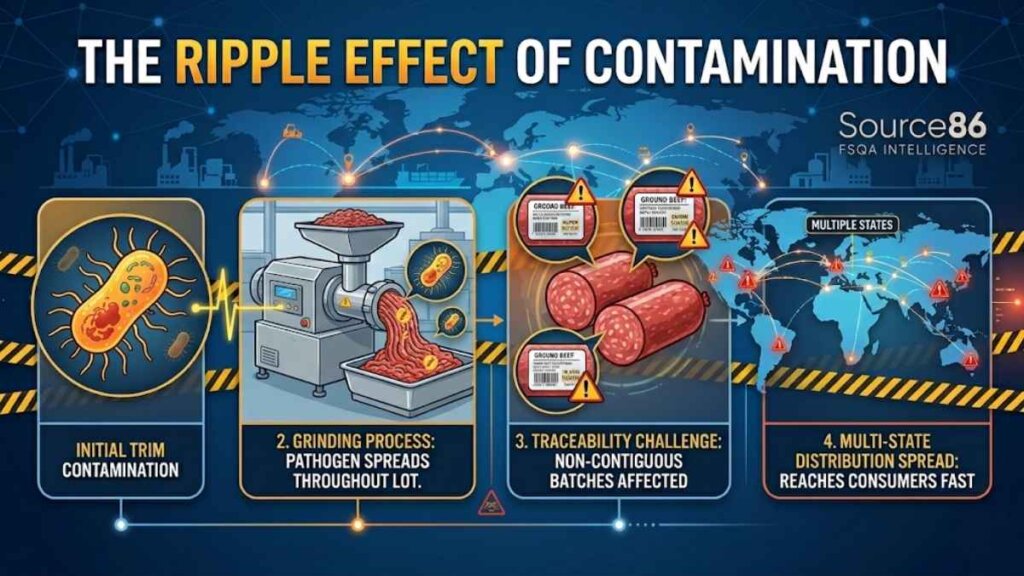
The answer lies in the complexity of the modern food supply chain. Today, the vast majority of food recalls aren’t caused by a single grocery store or a solitary kitchen making a mistake. They are the result of the Recall Ripple Effect, a phenomenon where one contaminated ingredient from a hidden supplier taints dozens, sometimes hundreds, of finished products downstream.
Here is why the “domino effect” is the hidden driver behind America’s largest food recalls, and what food safety (FSQA) professionals are doing to stop it.
The Myth of the “Isolated” Recall
When a consumer buys a ready-to-heat deli meal or a frozen dinner, they often assume the brand on the label created the entire product under one roof. In reality, modern food manufacturing is an assembly process.
A single frozen meal might contain chicken processed in Arkansas, rice imported from Asia, vegetables grown in Mexico, and a spice blend manufactured in Illinois.
If a pathogen like Salmonella or Listeria survives the manufacturing process of just one of those sub-ingredients (often referred to as Tier-2 or Tier-3 suppliers), that ingredient is shipped out to multiple consumer brands. Once those brands mix the contaminated spice or vegetable into their massive commercial batches, the entire lot is compromised.
The Domino Effect in Action: The 2026 Costco Meatloaf Recall
One of the clearest examples of the ripple effect happened in March 2026. Costco Wholesale issued a massive recall for its in-house deli item, the Meatloaf with Mashed Yukon Potatoes and Glaze, across 27 states.
Costco’s in-store deli didn’t suddenly forget how to wash their hands or sanitize their counters. Instead, Costco was the victim of a downstream supplier error. An ingredient supplier, Griffith Foods Inc., notified Costco that a component used in the meatloaf’s recipe had tested positive for Salmonella.
Because large retailers rely on standardized supplier bases, coatings, and glazes to keep their food tasting consistent nationwide, that single contaminated ingredient was shipped to Costco warehouses across half the country. When the supplier sounded the alarm, the dominoes fell, and Costco was forced to pull thousands of meals from its shelves.
Repackaging Blind Spots: When Labels Fall Like Dominoes
The ripple effect isn’t limited to bacteria and pathogens; it is also a major driver of allergen-related recalls.
When bulk ingredients are sold to a middleman for repackaging, vital food safety information can get lost in translation. In February 2026, Beacon Promotions had to recall 6,000 packs of promotional M&M’s handed out at corporate events because they forgot to transfer the milk, soy, and peanut allergy warnings from the bulk master case onto the small promotional wrappers.
The original manufacturer made the candy perfectly. But because a secondary handler broke the chain of information, thousands of dangerous, misbranded items entered the public sphere.
How Can the Industry Stop the Ripple Effect?
For food brands, co-packers, and retailers, surviving in a hyper-connected supply chain requires absolute visibility. You cannot simply trust that the ingredients arriving at your loading dock are safe; you have to verify it.
To prevent the domino effect, industry leaders rely on three critical pillars:
- Rigorous FSVP (Foreign Supplier Verification Programs): Ensuring imported ingredients meet the exact same safety standards as domestic ones.
- Certificates of Analysis (COA): Mandating that suppliers provide laboratory proof that a specific batch of spices, powders, or produce is free of pathogens before it is mixed into a finished product.
- Validated Kill-Steps: Ensuring that somewhere in the manufacturing process (like roasting, dehydrating at high heat, or pasteurization), pathogens are scientifically eradicated.
The Source86 Perspective
As recalls grow larger and more complex, brand reputation hinges on supply chain transparency. A brand is only as strong as its weakest ingredient supplier.
At Source86, we specialize in mitigating these exact risks. We help food brands manage global ingredient sourcing, navigate complex FSQA oversight, and build resilient private-label supply chains. We vet the suppliers so you don’t end up at the end of a recall domino effect.
To stay up-to-date on the latest food safety alerts, continue following the Source86 Recall Blog. If you need to secure your supply chain, contact our FSQA experts today.