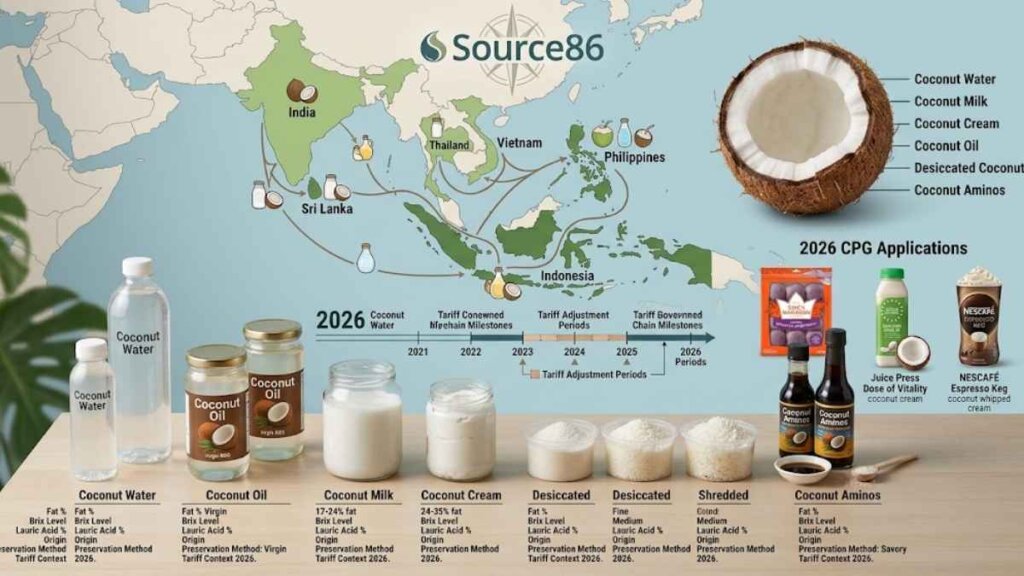
Coconut is everywhere in 2026. Coconut milk in King’s Hawaiian’s Ube Coconut Sweet Rolls. Coconut cream in the Dose of Vitality smoothie at Juice Press. Coconut whipped cream on the NESCAFÉ Espresso Keg drinks. Coconut water in functional beverage formulations. Coconut oil in clean-label cooking applications replacing seed oils under pressure from the seed oil avoidance movement. Coconut aminos replacing soy sauce in gluten-free and paleo-positioned food products.
What most CPG brands do not fully understand is that these are not variations of the same sourcing decision. Coconut milk and coconut cream and coconut oil and coconut water and desiccated coconut and coconut aminos are six distinct products with six distinct supply chains, six distinct quality specifications, and six distinct procurement challenges. Treating them as a single “coconut” sourcing category is one of the most common and most costly mistakes in clean-label food product development.
This is the guide we wish every CPG buyer had before they called us.
Where Coconuts Come From and Why It Matters
The global coconut supply chain runs through three primary producing countries: the Philippines, Indonesia, and Sri Lanka. India and Vietnam are secondary producers. Thailand, though smaller in production volume, is a significant processor and exporter of value-added coconut products.
The Philippines is the world’s largest exporter of coconut products by value. It leads in desiccated coconut, coconut cream, coconut milk, and virgin coconut oil exports. The vast majority of Philippine coconut production comes from smallholder farmers with one to three hectares of land, which creates supply chain fragmentation at the farm level that requires aggregation and quality standardization further up the chain.
Indonesia is the world’s largest coconut producer by volume. Its production is distributed across Sulawesi, North Sumatra, and the Maluku Islands. Indonesian coconut oil production, particularly RBD (refined, bleached, deodorized) coconut oil for food manufacturing applications, is among the most competitively priced in the global market.
Sri Lanka is the primary origin for premium virgin coconut oil and is recognized for producing some of the highest quality coconut-derived ingredients in the specialty food sector. Sri Lankan virgin coconut oil commands a price premium over Philippine and Indonesian equivalents because of the quality of the fruit and the production standards applied across the island’s coconut belt.
Understanding origin is not a geography lesson. It is a quality control input. The flavor profile, fat content, lauric acid percentage, moisture content, and shelf life characteristics of coconut products vary meaningfully by origin and by processing method. A CPG brand that specifies coconut milk without specifying origin and processing method is not specifying coconut milk. It is specifying a category.
The Six Coconut Products: What They Are and What They Require
Coconut water is the liquid found inside young green coconuts before the flesh develops fully. At peak harvest, a young coconut contains 200 to 1,000 ml of water with a natural electrolyte content including potassium, magnesium, sodium, and calcium. The flavor is mildly sweet, slightly nutty, and distinctly fresh at the point of harvest.
The commercial challenge with coconut water is preservation. Fresh coconut water begins to degrade rapidly after the coconut is opened, losing flavor brightness and developing off-notes within hours at ambient temperature. Commercial coconut water is either flash-pasteurized and aseptically packaged, high-pressure processed (HPP) for refrigerated distribution, or thermally treated for ambient shelf-stable distribution.
Each preservation method produces a different sensory result. HPP coconut water most closely resembles fresh, with minimal flavor degradation. Flash-pasteurized aseptic coconut water is slightly cooked in flavor. Thermally processed ambient coconut water carries the most pronounced cooked character. For CPG formulations where coconut water is a featured ingredient, the preservation method selection is as important as the origin selection.
For brands using coconut water as a functional beverage ingredient in 2026, the sourcing specification must address: origin (Philippines, Indonesia, Sri Lanka, Thailand, or Brazil for a distinct flavor profile), preservation method (HPP, aseptic, ambient), Brix level (natural sugar concentration), sodium content (varies significantly by harvest region), and microbiological standards for the intended application.
Coconut Milk
Coconut milk is produced by grating the white flesh of a mature coconut and pressing it with water to extract the fat and flavor compounds into a liquid emulsion. Full-fat coconut milk contains 17 to 24% fat by weight and delivers the rich, creamy body that defines coconut milk’s culinary function across Thai curries, South Asian gravies, and CPG food applications.
The fat content of coconut milk is its primary functional specification for CPG use. In a baked good application (like King’s Hawaiian’s Ube Coconut Sweet Rolls), the fat contributes to crumb softness and moisture retention in the same way that dairy milk fat does. In a frozen dessert or beverage application, the fat content determines the creaminess and mouthfeel of the finished product. In a sauce or curry application, the fat content determines the emulsification stability and richness of the finished sauce.
Commercial coconut milk is available in full-fat and reduced-fat formats, in canned and aseptic carton packaging, and with and without added stabilizers (guar gum, xanthan gum, or carrageenan) that prevent fat separation during storage. For clean-label applications, additive-free coconut milk is required, which narrows the supplier pool and typically raises the per-unit cost because stabilizer-free coconut milk requires more careful temperature control throughout the supply chain.
Coconut Cream
Coconut cream is the first press of grated mature coconut flesh with minimal added water, producing a very high-fat emulsion (typically 24 to 35% fat) with a thick, almost spreadable consistency. It is the fat-richest of the coconut products and the most concentrated in flavor intensity.
For CPG applications, the distinction between coconut milk and coconut cream matters practically. A recipe that calls for coconut cream but receives coconut milk will produce a thinner, less rich result that fails the sensory specification. A recipe that calls for coconut milk but receives coconut cream will produce a richer, denser result that may alter the texture and caloric profile of the finished product.
In 2026, coconut cream is seeing growing application in dairy-free whipped topping systems (like the Dose of Vitality smoothie), plant-based ice cream formulations, and premium cooking sauces where a thick, rich coconut base is the functional and flavor foundation. For brands formulating plant-based dairy alternatives, coconut cream’s fat content and emulsification behavior make it one of the most effective dairy fat replacers available without requiring additional processing or hydrogenation.
Coconut Oil
Coconut oil exists in two fundamentally different commercial forms: virgin (or extra-virgin) and RBD (refined, bleached, deodorized). They are not interchangeable and they are not sourced from the same supply chain.
Virgin coconut oil is cold-pressed from fresh coconut meat without heat or chemical treatment. It retains the characteristic coconut flavor and aroma, a white or slightly off-white color in solid form, and a natural lauric acid content typically above 48%. Virgin coconut oil is the premium format used in clean-label cooking, as a direct-consumption functional oil, and in personal care applications. It commands a price two to three times that of RBD coconut oil.
RBD coconut oil is produced from dried coconut meat (copra) using a solvent extraction or mechanical pressing process followed by refining, bleaching, and deodorizing steps that remove the flavor, aroma, and color of the natural oil. The result is a flavorless, odorless oil with a neutral sensory profile suitable for food manufacturing applications where coconut flavor is not desired. RBD coconut oil is the format used in commercial baking, confectionery coating systems, and food manufacturing applications where a stable, high-lauric-acid fat is needed without the coconut flavor character.
The distinction matters for CPG procurement. A brand that wants to use coconut oil in a chocolate coating system does not want virgin coconut oil: the coconut flavor would interfere with the chocolate. A brand that wants to market “virgin coconut oil” as a featured ingredient in a premium cooking product cannot substitute RBD without losing both the flavor and the label claim.
In 2026, coconut oil is one of the primary beneficiaries of the seed oil replacement movement. Consumers actively avoiding soybean oil, canola oil, sunflower oil, and other polyunsaturated seed oils are turning to coconut oil (along with avocado oil, tallow, and ghee) as alternatives. For CPG brands reformulating away from seed oils, RBD coconut oil provides a cost-effective, flavor-neutral, seed-oil-free fat system for baking, frying, and food manufacturing applications.
Desiccated Coconut
Desiccated coconut is the dried and shredded or flaked flesh of a mature coconut, produced by removing moisture from freshly grated coconut meat to a final moisture content typically below 3%. It is available in fine, medium, and coarse grinds and in shredded and flaked formats, each with distinct functional behavior in different food applications.
Desiccated coconut for CPG use has a very specific quality specification: moisture content, oil content, sulfite content (unsulfured vs. sulfured), particle size distribution, and microbiological standards are all critical parameters. Sulfited desiccated coconut extends shelf life but disqualifies the product from clean-label and organic-certified applications. Unsulfured desiccated coconut has a shorter shelf life but is compatible with organic certification, clean-label programs, and applications where no artificial preservatives are permitted.
In granola bars, trail mixes, baked goods, and confectionery applications, desiccated coconut contributes flavor, texture, and fat. Its oil content (typically 60 to 65% on a dry weight basis) makes it one of the highest-fat botanical inclusions used in commercial food production. That fat content must be accounted for in finished product nutritional calculations and in the stability assessment of the finished product’s shelf life, particularly in applications where the desiccated coconut is exposed to air or moisture that could accelerate oxidative rancidity.
Coconut Aminos
Coconut aminos is a fermented soy sauce alternative made from the sap of coconut palm flowers (not coconut fruit), which is collected, fermented with sea salt, and aged to produce a dark, savory liquid condiment. Despite its name, coconut aminos does not taste strongly of coconut. Its flavor profile is savory, mildly sweet, and slightly umami, with a lower sodium content than conventional soy sauce.
The primary commercial driver for coconut aminos is dietary positioning. It is gluten-free (unlike traditional soy sauce, which contains wheat), soy-free, and paleo-certified, making it the condiment of choice for brands formulating for paleo, Whole30, gluten-free, and soy-free dietary frameworks. Its sodium content is typically 90 to 300 mg per teaspoon versus 960 mg for conventional soy sauce, making it relevant for low-sodium positioning.
For CPG brands, coconut aminos as a formulation ingredient requires a quality specification that addresses fermentation time and acidity level (which affect both flavor intensity and shelf life), sodium content (which varies by producer and affects nutritional label claims), and the source of the coconut palm sap (Philippines is the primary origin, with production concentrated in the Visayas region).
The 2026 Tariff Context and What It Means for Coconut Sourcing
The 2026 tariff environment has created meaningful cost pressure for all imported coconut products, which originate almost entirely from Southeast Asia. Philippine and Indonesian coconut exports to the U.S. are subject to the tariff structure that has been in active flux since early 2026.
The practical implication for CPG brands is that coconut product costs are not stable and cannot be budgeted on historical pricing alone. The landed cost of coconut milk, coconut oil, desiccated coconut, and coconut water from the Philippines and Indonesia in 2026 includes a tariff component that was not present in the same product’s 2024 cost. For brands with coconut ingredients in their formulations, this creates a direct margin impact that must be either absorbed, passed through in retail pricing, or offset through supplier negotiation and alternative sourcing.
Sri Lankan origin coconut products are subject to a different tariff treatment than Philippine and Indonesian products in several trade categories. For brands that have flexibility in origin specification, Sri Lanka can represent both a quality upgrade (particularly for virgin coconut oil) and a tariff optimization opportunity in the current environment. This is a sourcing conversation worth having with your ingredient partner before your next purchase order.

What to Ask Before You Source
Before placing a purchase order for any coconut ingredient, the questions that protect your formulation, your label, and your margin are:
What is the origin? Philippines, Indonesia, Sri Lanka, and Thailand produce materially different quality profiles and carry different tariff implications in 2026.
What is the fat content? For coconut milk and coconut cream, fat content determines the functional performance in your application. A specification without a fat content range is not a specification.
Is it organic certified? If your finished product carries an organic claim, every ingredient must be certified. Organic coconut products require a supplier with active USDA NOP certification documentation.
Is it additive-free? If your product carries a clean-label claim (no artificial additives, no stabilizers), you need written confirmation that no guar gum, carrageenan, xanthan gum, or other stabilizing agents are present.
What is the moisture content? For desiccated coconut, moisture content determines shelf life and microbiological safety. A moisture content above specification creates mold risk.
What is the packaging and shelf life at point of arrival? Import transit from Southeast Asia takes three to six weeks by sea. Shelf life must be sufficient to accommodate transit, customs clearance, warehouse staging, and your production cycle before the ingredient expires.
Why Source86
Source86 sources coconut products across all six format categories, including coconut water, coconut milk, coconut cream, virgin and RBD coconut oil, desiccated coconut, and coconut aminos, from qualified suppliers across the Philippines, Indonesia, and Sri Lanka. Every ingredient comes with full documentation: certificates of analysis, allergen declarations, country of origin documentation, and organic or non-GMO certification where applicable.
If your team is building a formulation that uses any coconut ingredient, or if you are reviewing your current coconut sourcing against the 2026 tariff environment, reach out to Source86 and let’s start the conversation.