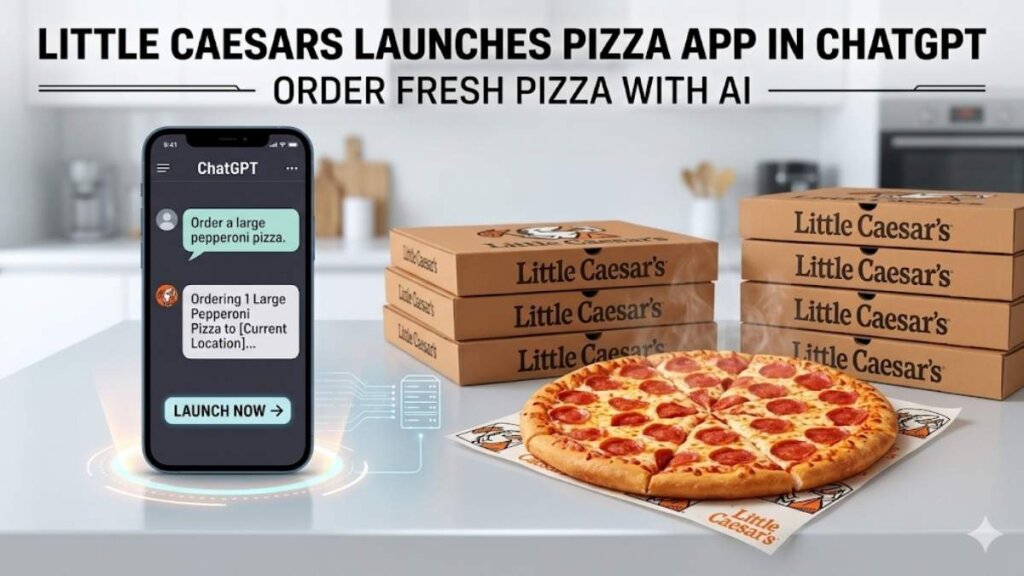
Little Caesars announced on April 16, 2026 the launch of a Pizza App in ChatGPT, described as the first of its kind, enabling customers to order Little Caesars pizza through natural language conversation in ChatGPT. The app is rolling out nationally across all Little Caesars markets in the U.S. and many restaurants in Mexico and Canada. Customers access it by opening ChatGPT, visiting the app directory, searching for “Little Caesars,” and connecting their account. The ChatGPT interface handles menu browsing, personalized recommendations, and cart building, then hands off to the Little Caesars app or LittleCaesars.com for checkout and in-store pickup.
Little Caesars was founded in 1959 by Mike and Marian Ilitch as a single family-owned restaurant in Detroit, Michigan, and is now headquartered in downtown Detroit. It is the third-largest pizza chain in the world, with restaurants in all 50 U.S. states and over 30 countries and territories. Little Caesars operates in the $150 billion worldwide pizza industry and is the Official Pizza Sponsor of the NFL. The brand is part of the Ilitch Companies family of businesses. Greg Hamilton, Chief Marketing Officer at Little Caesars, and Anita Klopfenstein, Global Chief Information and Digital Officer, are the company spokespersons for this launch.
How the ChatGPT Pizza App Works
The ordering flow works through ChatGPT’s app directory rather than through a standalone app or website. A customer opens ChatGPT, connects their Little Caesars account through the app directory, and then describes what they want in natural language. The system uses real-time access to Little Caesars’ menu data, pricing, and store locator to process the conversation, interpret preferences, and build a cart recommendation. Once the cart is ready, the handoff to the Little Caesars app or LittleCaesars.com for final checkout and in-store pickup completion happens through deep linking, a technical mechanism that carries cart data from one application to another without requiring the customer to re-enter their order.
The system is designed to handle inputs that go beyond simple “I want a pepperoni pizza” requests. According to the announcement, it can process group-size planning (how many people are being fed), dietary needs, budget constraints, delivery preferences, and personal preference histories, then generate personalized meal recommendations from those inputs. This means a customer can say “I need to feed eight people for under $30, a few of them don’t eat meat” and receive a specific, priced, buildable cart recommendation rather than a generic menu suggestion.
Anita Klopfenstein, Global Chief Information and Digital Officer, stated:
“We’ve built a sophisticated backend that enables ChatGPT to access our menu, pricing, and store locator data in real-time while maintaining security and compliance standards. This is just the beginning of how AI will transform the restaurant industry.”
Why Little Caesars Is the Structurally Correct QSR to Launch This First
The ChatGPT pizza app announcement is more significant as a QSR-specific launch than it would be for most other restaurant categories because Little Caesars’ HOT-N-READY model creates the ideal conditions for AI-assisted ordering to generate genuine consumer value.
Most QSR ordering friction comes from indecision at the point of purchase: too many options, unclear pricing, group-size uncertainty, and dietary constraint reconciliation. These are exactly the problems that conversational AI is well-suited to resolve. A customer who types “what’s the best deal for a family of five tonight” into ChatGPT and receives a specific, priced answer with a ready-to-checkout cart has had a materially better ordering experience than the same customer navigating a multi-category mobile app menu under the same conditions.
Little Caesars’ HOT-N-READY positioning, built around a narrow, pre-made, immediately available menu at a transparent value price point, means the conversational AI does not need to manage the complexity of a fully customizable build-your-own menu with dozens of modifier options. The AI’s recommendation outputs map onto a finite set of ready-to-fulfill products. For customers ordering for groups on a budget, which is explicitly the target scenario the announcement describes as “pizza party planning,” the ChatGPT interface reduces the decision overhead at exactly the moments that matter most.
The HOT-N-READY model also means inventory is predictable and immediate. A chatbot that recommends a specific order does not need to hedge for wait times or out-of-stock items the way a more customized QSR would. The simplicity of the fulfillment model is what makes the AI ordering layer trustworthy from a consumer perspective.
The Technical Architecture: Real-Time Menu Access and Deep Linking
The announcement discloses two technical elements that are worth examining for QSR technology and supply chain audiences: real-time data access and deep linking.
Real-time menu, pricing, and store locator data access means the ChatGPT app is pulling live information from Little Caesars’ backend systems rather than working from a static data snapshot. This requires Little Caesars to have an API architecture that can expose menu and location data to a third-party AI platform at the query frequency that ChatGPT conversations generate. For a chain with restaurants across all 50 states and over 30 countries, maintaining real-time menu accuracy across that footprint, including local market pricing variations and store availability, is a non-trivial data infrastructure requirement.
Deep linking between ChatGPT and the Little Caesars app is the handoff mechanism that makes the ordering flow commercially viable. Without deep linking, a customer would have to manually re-enter their ChatGPT-built cart in the Little Caesars app, which would eliminate most of the friction reduction the ChatGPT interface created. The deep link carries the cart data from ChatGPT to the Little Caesars app checkout screen, where the customer completes the transaction. This means Little Caesars’ app infrastructure already had the deep linking capability built into its mobile architecture, and the ChatGPT integration leveraged that existing investment rather than requiring a new fulfillment system.
The Broader QSR Implication: AI as a New Ordering Channel
This launch places Little Caesars at the leading edge of a channel transition that is happening across the restaurant industry. The announcement quotes Greg Hamilton, CMO:
“Today’s consumers are turning to GenAI as part of how they search for everything, including where to get their next meal. We recognize this shift and want to meet our customers where they already are.”
That framing is precise and accurate. AI-assisted search and task completion through tools like ChatGPT has already displaced a meaningful portion of traditional search engine queries for product discovery and recommendation. The food ordering category is a natural extension of that behavior. A consumer who uses ChatGPT to plan a meal, compare restaurant options, or decide between menu items is performing tasks that previously required opening a restaurant app, reading a menu, and making decisions without conversational assistance.
For QSR operators watching Little Caesars’ move, the question is not whether AI ordering interfaces will matter but which chains will build the backend infrastructure to support them before consumer expectations shift. Little Caesars is announcing that their app infrastructure, real-time data access, and deep linking capabilities are already ready. The ChatGPT app is the consumer-facing product built on top of that infrastructure.
Why It Matters for Pizza Ingredient Suppliers and QSR Co-Manufacturing Partners
Little Caesars’ ChatGPT integration creates a new category of demand signal data that its ingredient and co-manufacturing partners should understand: AI-mediated order composition. When a consumer builds a cart through a conversational AI, the AI’s recommendation logic influences which products appear in that cart. If the ChatGPT system consistently recommends the HOT-N-READY Classic Round in response to “best value for a family of five,” that recommendation logic becomes a de facto demand driver for the Classic Round’s specific ingredient inputs, including the fresh, never-frozen mozzarella and Muenster cheese blend and the fresh-packed, vine-ripened California crushed tomato sauce that the announcement highlights as product differentiators. For Little Caesars’ cheese suppliers and tomato sauce ingredient partners, the ChatGPT ordering layer is a new factor in the demand planning environment that did not exist before April 16, 2026.
The “fresh, never-frozen mozzarella and Muenster cheese” and “fresh-packed, vine-ripened California crushed tomatoes” specifications remain the sourcing anchor of Little Caesars’ product identity regardless of how consumers place orders. The announcement explicitly names these ingredient credentials in the brand description, confirming that the technology investment does not alter the underlying product sourcing standards. For mozzarella and Muenster cheese processors supplying Little Caesars across its national distribution network, and for California tomato processors providing fresh-packed crushed tomato sauce inputs, the ChatGPT launch is a channel expansion that increases order volume potential without changing the ingredient specifications those suppliers are already producing to.
A ChatGPT ordering channel that handles group-size and budget planning optimally tends to drive orders toward the highest-value-per-person menu configurations, which at Little Caesars means larger-format or multi-item orders. AI systems optimizing for the stated consumer goal of “feeding X people for Y budget” will consistently find configurations that maximize food quantity per dollar, and Little Caesars’ HOT-N-READY pricing makes those configurations highly visible and easy to recommend. For dough, sauce, and cheese suppliers calibrating production planning around Little Caesars’ order mix, an AI ordering channel that nudges toward efficient group orders may shift the mix modestly toward larger-format products over single-serve items.

FAQs
What is the Little Caesars ChatGPT Pizza App? A first-of-its-kind ordering integration launching April 16, 2026, allowing customers to order Little Caesars pizza through conversational AI in ChatGPT. Available nationally across all U.S. Little Caesars markets and many locations in Mexico and Canada.
How does a customer use it? Open ChatGPT, visit the app directory, search for “Little Caesars,” and connect your account. Describe what you want in natural language. ChatGPT builds a personalized cart using real-time menu and pricing data, then hands off to the Little Caesars app or LittleCaesars.com for checkout and in-store pickup.
What can the AI help with? Group-size planning, dietary needs, budget constraints, delivery preferences, and personalized recommendations based on stated preferences.
What products does Little Caesars use this AI ordering to highlight? The announcement emphasizes fresh, never-frozen mozzarella and Muenster cheese and sauce made from fresh-packed, vine-ripened California crushed tomatoes as core product credentials.
Who operates Little Caesars? Founded in 1959 by Mike and Marian Ilitch, headquartered in Detroit, Michigan. Third-largest pizza chain in the world, with locations in all 50 U.S. states and over 30 countries and territories. Part of the Ilitch Companies family of businesses and Official Pizza Sponsor of the NFL.
About Source86
Little Caesars’ ChatGPT ordering launch reinforces the brand’s sourcing commitments across its national and international franchise network, maintaining sustained demand for fresh, never-frozen mozzarella and Muenster cheese inputs at the protein and fat specifications required for a HOT-N-READY ambient-hold pizza model, fresh-packed and vine-ripened California crushed tomato inputs for sauce production at pizza chain scale, enriched wheat flour and dough inputs for a high-volume HOT-N-READY pizza production model, and the real-time supply chain visibility infrastructure that allows a national pizza chain to expose live menu and pricing data across thousands of franchise locations to a third-party AI ordering platform. At Source86, we connect pizza chain operators, franchise restaurant systems, and foodservice ingredient distributors with trusted bulk and wholesale sourcing partners for fresh mozzarella and cheese blend inputs, California tomato sauce ingredients, bread-grade flour systems, and the supply chain infrastructure that supports high-volume pizza production at national franchise scale across grocery, convenience, and direct-to-consumer restaurant channels.
Whether your production team sources fresh mozzarella for a never-frozen pizza cheese application, fresh-packed California tomato inputs for a pizza sauce program, or flour systems for a high-volume franchise pizza production operation, Source86 is your bridge to the right manufacturing and supply chain partners. Contact Source86 today to start your sourcing search.