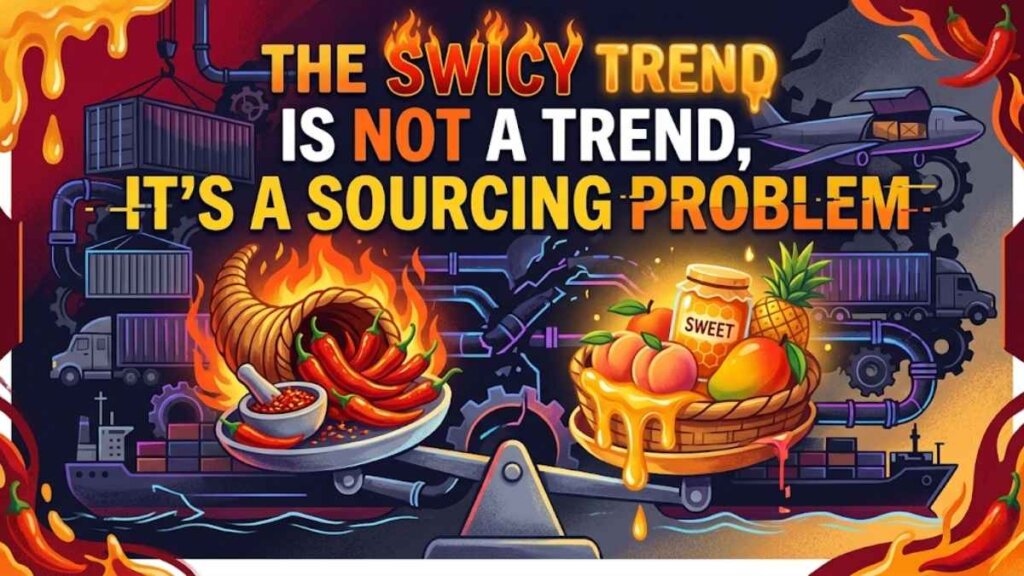
Everyone is talking about swicy. Sweet meets spicy. The flavor combination that took over QSR menus, CPG launches, and food media in 2025 and accelerated hard into 2026. Chipotle called it out by name in its Honey Chicken announcement. Wendy’s built three jalapeño items in a single spring menu drop. Taco Bell brought datil pepper to its Chicken Ranch Nacho Fries. McCormick named a complex heat-adjacent flavor its 2026 Flavor of the Year. Cleveland Kitchen put gochugaru in a Walmart refrigerated coleslaw.
The consumer narrative around swicy is straightforward: people want heat and sweetness together, they want the contrast, and they want it across every daypart and format. That narrative is correct. But it misses what actually matters for CPG and QSR operators.
Swicy is not a flavor trend that resolves itself at the marketing level. It is a sourcing problem. And most brands have not solved it yet.
What “Swicy” Actually Requires at the Ingredient Level
The challenge with swicy is that it sounds simple and is not. Two flavors: sweet and spicy. One product. Done.
The reality is that sweet and spicy are sourced from entirely different ingredient supply chains, processed through entirely different manufacturing systems, and behave in entirely different ways in a finished food application. Making them coexist in a single product that delivers both sensations distinctly, in the right sequence, at the right intensity, is a formulation and sourcing challenge that scales in difficulty with the complexity of the application.
Start with the sweet side. The most commercially successful swicy products in 2026 are not using generic sweetener systems. Chipotle Honey Chicken (https://source86.com/chipotle-honey-chicken-return-april-2026-high-protein-cup) uses pure honey, not a honey-flavored compound or corn syrup blend. That is a deliberate choice with sourcing implications: pure honey at QSR scale requires bulk honey suppliers who can deliver at the purity, traceability, and volume standards required for a clean-label marinade application across 4,000-plus locations. The honey sourcing program is not a condiment procurement. It is an agricultural commodity program.
Cleveland Kitchen’s Hot Honey Jalapeños (https://source86.com/cleveland-kitchen-walmart-fermented-foods-expansion-2026) use real honey in a pickled format alongside jalapeño peppers in a refrigerated fermented condiment. Same underlying sweet input, completely different application and supply chain. The honey must be stable in an acidified, live-culture environment across refrigerated shelf life.
Maple syrup, fruit concentrates, agave, and coconut sugar are appearing in swicy applications as the honey supply tightens and brands seek differentiation. Each brings its own sourcing geography, processing complexity, and functional behavior in the finished product.
Now the spicy side. This is where the sourcing diverges even more sharply.
The Spice Supply Chain Is Not One Supply Chain
Consumer descriptions of “spicy” cover an enormous range of actual heat delivery systems. The ingredient sourcing behind each one is distinct.
Jalapeño is the most widely applied spicy ingredient in U.S. QSR in 2026. Wendy’s used it across three menu items and two dayparts simultaneously in its April spring menu drop (https://source86.com/wendys-spring-menu-2026-cookie-dough-frosty-watermelon-jalapeno). Long John Silver’s Frank’s RedHot Buffalo lineup is anchored on aged cayenne and vinegar, but jalapeño derivatives sit across the sauce and topping system. Laredo Taco Company’s Walking Taco uses fresh pico de gallo with jalapeño. For fresh jalapeño applications, the supply chain runs through Mexico and the U.S. Southwest, with IQF and fresh-cut processing options that differ significantly in flavor intensity, texture, and shelf life behavior. For pickled jalapeño applications, the acidity level and brine system affect heat perception and require a vinegar and acidification sourcing program alongside the pepper inputs. For jalapeño-derived flavor compounds in sauce systems like Freddy’s Jalapeño Fry Sauce, a natural flavor manufacturer extracts and concentrates the capsaicin and flavor compounds from jalapeño for a consistent, pourable application across franchise locations.
Chipotle pepper (smoked and dried jalapeño) is a different product with a different supply chain. Chipotle Mexican Grill’s entire brand identity is built on the chipotle pepper. The Honey Chicken uses it as the primary heat and smoke input in the marinade. At 4,000-plus locations, Chipotle’s chipotle pepper procurement program is one of the largest single-brand smoked chile sourcing programs in U.S. foodservice. The smoking and drying process, typically applied to red-ripe jalapeños in Mexico before export, requires agricultural inputs, smoke processing facilities, and moisture content specifications that distinguish it entirely from fresh or pickled jalapeño sourcing.
Gochugaru is Korean red pepper flake, sun-dried and coarsely ground from a specific Capsicum annuum variety. Cleveland Kitchen’s Korean Coleslaw, now in 500-plus Walmart refrigerated produce locations (https://source86.com/cleveland-kitchen-walmart-fermented-foods-expansion-2026), introduced gochugaru as a retail mass-market ingredient in a fermented produce application. Gochugaru’s flavor is moderately spicy, slightly sweet, and distinctly smoky. It is almost entirely imported from South Korea and China. For food manufacturers moving into Korean-inspired swicy applications, gochugaru requires an import program with food-grade quality, consistent Scoville range, and color stability across refrigerated or shelf-stable shelf life.
Frank’s RedHot is a manufactured branded sauce system: aged cayenne, distilled vinegar, water, salt, and garlic powder. When a QSR like Long John Silver’s uses Frank’s RedHot as a tossing sauce, the ingredient procurement is a finished sauce purchase from a branded foodservice supplier. But the underlying cayenne pepper and vinegar inputs that define Frank’s RedHot’s flavor are the actual commodity inputs driving the supply chain behind it.
Togarashi (shichimi togarashi, the Japanese seven-spice blend) appeared in April 2026 at P.F. Chang’s on its NY Prime Strip Steak Tataki. It requires a multi-component spice import program: red chili pepper, sansho, orange peel, black sesame, white sesame, hemp seed, and ginger, all blended at a consistent ratio for a single restaurant application. For P.F. Chang’s at 300-plus locations, that is a specialty import procurement program for a seasoning blend where each of the seven components must individually meet food-grade and quality specifications.
The Sequence Problem: Heat and Sweet Cannot Arrive at the Same Time
Here is the formulation insight that most marketing discussions of swicy miss entirely: the best swicy products don’t deliver heat and sweetness simultaneously. They deliver them in sequence.
Heat first, then sweet. Or sweet first, then heat. The sequencing is what creates the experience. A product where heat and sweetness arrive at the same moment reads as confused rather than complex to the palate.
Chipotle Honey Chicken is designed as heat-first, sweet-second. The chipotle pepper marinade penetrates the protein during cooking. The honey is applied as a finishing element. The eating experience delivers the smoky heat of chipotle first and the sweetness of honey as a lingering back note. That sequencing is not accidental. It is a formulation decision that determines how the two ingredients are applied in the production process: one in the marinade, one in the finish.
For QSR and CPG manufacturers trying to build swicy products, the sequence question has direct sourcing implications. A heat-first product requires the spice input to be integrated into the base formulation before the sweet input is applied. A sweet-first product requires the opposite. A product where both are surface-applied simultaneously tends to read as neither heat-forward nor sweet-forward, and performs poorly against products that make the sequencing explicit.
Getting the sequence right requires ingredient sourcing at a specification that supports the intended application point. A jalapeño compound designed for a sauce base behaves differently in a marinade application. A honey formulated for a glaze application behaves differently in a dough inclusion. The sourcing specification must match the application method, and the application method must match the intended flavor sequence.
Why Most Brands Are Getting This Wrong
The easiest version of a swicy product is a sweet base with a hot sauce applied on top. It works at the consumer perception level because the customer experiences sweet from the base and heat from the sauce, and those two sensations together qualify as swicy. But it does not create the genuine flavor complexity of the best swicy products, and it limits the brand’s ability to control the heat level, the sweet level, and the sequence consistently across production runs.
The reason most brands go this route is not because their product developers don’t understand the formulation challenge. It’s because sourcing two distinct, high-specification ingredient systems for a single product doubles the procurement complexity, the supplier qualification requirement, and the quality control burden. Sourcing pure honey and chipotle pepper for a chicken marinade at 4,000-plus QSR locations is a different supply chain problem than sourcing a pre-blended honey-chipotle sauce from a single co-manufacturer. Chipotle has built the infrastructure for the former. Most operators default to the latter.
The brands winning in swicy in 2026 are the ones who have treated the sweet ingredient and the spicy ingredient as separate, specification-driven sourcing decisions rather than a single compound flavor purchase. Pure honey at marinade grade. Aged cayenne at sauce manufacturing specification. Gochugaru at refrigerated fermented produce import specification. These are not the same ingredient decisions, and they are not solvable through the same supply chain.
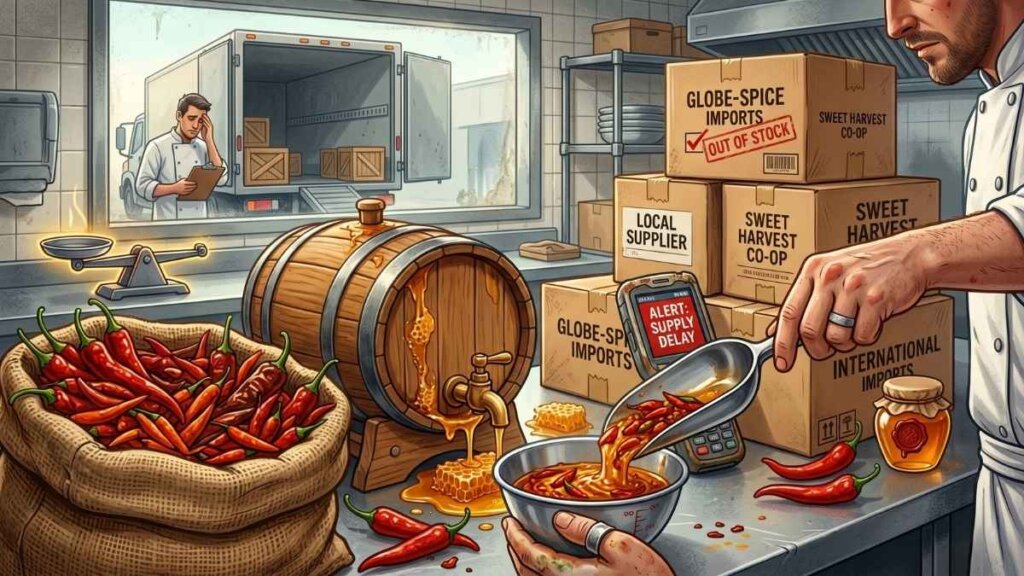
As we covered in our 5 CPG ingredient trends shaping 2026 (https://source86.com/cpg-ingredient-trends-2026-wellness-sustainability/), the clean-label movement is raising the bar on every input in a formulation. In a swicy application, that means both the sweet and spicy inputs must carry their own sourcing integrity. A pure honey claim requires a verifiable honey sourcing program. A natural jalapeño heat claim requires a documented pepper input rather than a synthetic capsaicin analog. The trend and the sourcing requirement are the same problem.
The Commercial Stakes Are Real
The swicy category is growing faster than the broader flavor market. Innova Market Insights reported in 2025 that sweet and spicy combinations were among the top five flavor trends globally, with North America leading adoption. PepsiCo’s own January 2026 consumer survey found that bold, complex flavors are the single biggest driver of snack trial among all consumer age groups.
Every major QSR and CPG brand is making at least one swicy product decision in 2026. The brands that source the sweet and spicy inputs as a single blended commodity will produce swicy products that work at the label level but fail to differentiate at the flavor level. The brands that source the two sides of the equation separately, at the specification required for the intended application, will produce the products that drive the repeat purchase that makes swicy commercially durable rather than a one-cycle trend.
The sourcing infrastructure for swicy is not complicated. It requires a bulk pure honey or fruit concentrate program, a chile pepper or chile-derived flavor program, and a manufacturing process designed to apply them at different stages. Source86 sources both sides of that equation. If your team is building a swicy product and needs the right supplier relationships for the sweet or spicy inputs, reach out to Source86 (https://source86.com/contact/) and let’s solve the sourcing problem behind the trend.