- Date issued: April 11, 2025
- Announced by: FDA on April 11, 2025
- Company: Blue Ridge Beef
- Products recalled: Puppy Mix and Kitten Mix (2 lb logs)
- Issue: Contamination with Salmonella and Listeria monocytogenes
- How to identify: Check for Lot # N25 1230 (Puppy) and N26 0114 (Kitten) stamped on the clips of the bag ends
- Distribution: Sold in retail stores in 9 states including NY, PA, MA, VA, and WI
- What to do: Return or destroy affected product; sanitize surfaces and wash hands thoroughly
- Why it matters: Contaminated pet food poses health risks to both pets and humans
Stick around for a deeper dive into this recall!
What happened?
Blue Ridge Beef, a North Carolina-based raw pet food manufacturer, voluntarily issued a recall on April 11, 2025, following test results that confirmed Salmonella and Listeria contamination in two of its products: Puppy Mix and Kitten Mix.
The recall was initiated after a customer reported an animal illness. The New York State Department of Agriculture and Markets collected samples on March 20, and by April 1, the North Carolina Department of Agriculture confirmed the contamination.
Here’s a quick breakdown of the affected products:
Brand | Product | Size | Lot # | UPC | Best By Date | Issue |
Blue Ridge Beef | Puppy Mix | 2 lb | N25 1230 | N/A | N/A | Salmonella & Listeria detected |
Blue Ridge Beef | Kitten Mix | 2 lb | N26 0114 | N/A | N/A | Salmonella & Listeria detected |
Where was it sold?
Retailers in Virginia, Maryland, Pennsylvania, Connecticut, Massachusetts, New York, Tennessee, Rhode Island, and Wisconsin carried the affected products.
What caused the issue?
This recall comes down to a one-two punch of bacterial contamination: Salmonella and Listeria monocytogenes—two notorious troublemakers in the food safety world. After a customer reported a pet illness, product samples were tested by the New York State Department of Agriculture, and the results weren’t good. By April 1, 2025, the North Carolina Department of Agriculture confirmed the presence of both bacteria.
Salmonella
A bacteria commonly associated with raw meat and poultry, Salmonella can infect both pets and humans. It’s tough on the stomach and can cause anything from discomfort to life-threatening conditions if left untreated—especially in high-risk groups.
Listeria monocytogenes
This one’s sneakier. It survives in cold temperatures (yes, even the fridge!), making it extra dangerous in frozen or refrigerated foods. Listeria poses an especially high risk to pregnant women, older adults, and immunocompromised individuals, potentially leading to severe infections or miscarriages.
Who’s at risk?
- Pets (especially puppies and kittens with weaker immune systems)
- Children under 5
- Adults over 65
- Pregnant women
- Immunocompromised individuals (e.g., undergoing chemo, with autoimmune disorders)
- Anyone handling pet food without proper sanitation
Symptoms to watch for
In humans:
- Nausea or vomiting
- Diarrhea or bloody stool
- Abdominal cramping
- Fever
- Muscle pain
- Headache or confusion (Listeria-specific in severe cases)
In pets:
- Lethargy
- Fever
- Vomiting
- Diarrhea (sometimes bloody)
- Decreased appetite
- Abdominal discomfort
Infected pets may also be silent carriers, passing pathogens to other animals—or you.
10 common questions you might have
1. Is this recall serious?
Yes, very. Both Salmonella and Listeria can cause serious illness in pets and humans, especially vulnerable groups.
2. Can I get sick from just touching the product?
Yes. Even handling contaminated food or packaging can transfer bacteria to your hands, surfaces, and eventually, your mouth or food.
3. My pet ate some—what should I do?
Watch for symptoms like vomiting, fever, or diarrhea. Contact your vet immediately and mention the recall.
4. I don’t see the lot number—is my product safe?
If the clip is missing or unreadable, don’t risk it. When in doubt, throw it out.
5. Can I return the recalled product?
Yes—return it to the place of purchase for a refund, or dispose of it in a way that animals and children can’t access it.
6. How should I clean up?
Disinfect pet bowls, utensils, storage bins, and any surface that came into contact with the food. Wash hands thoroughly with soap and hot water.
7. Is it safe to buy Blue Ridge Beef in the future?
The company has taken steps to address the issue, but stay alert. Always check lot numbers and FDA updates.
8. Are these bacteria killed by freezing?
Nope. Both Salmonella and Listeria can survive freezing temperatures. That’s part of the danger.
9. How often do pet food recalls happen?
More often than you’d think—especially with raw or minimally processed pet foods. See recent FDA recall alerts here.
10. Can I just cook the product to kill the bacteria?
Technically yes—but this product is not intended to be cooked. Feeding cooked food to pets meant to eat raw can pose nutritional risks. Best to discard.
Here’s what you should do

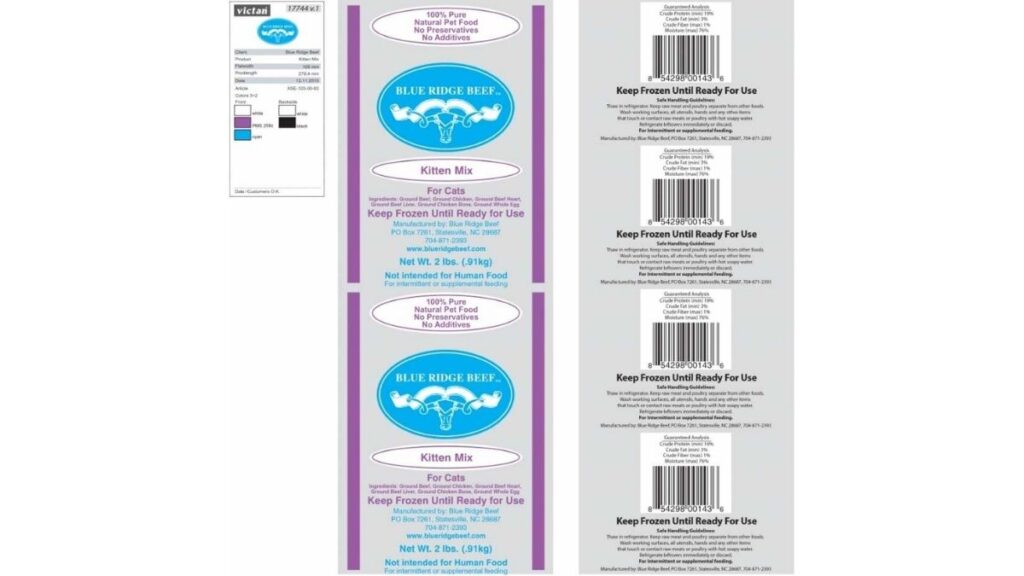
- Check the clip: Lot numbers are stamped on the metal clip sealing the chub logs.
- Dispose safely: Destroy the product so children, animals, or wildlife can’t access it.
- Don’t donate or sell. This isn’t a second-chance situation.
- Sanitize everything: From bowls to countertops and your hands—clean thoroughly.
- Contact Blue Ridge Beef:
- 704-873-2072 (M–F, 8am–5pm EST)
- [email protected]
Behind the brand
Blue Ridge Beef specializes in raw frozen pet food. While the brand has a loyal base among raw diet pet enthusiasts, this isn’t its first recall related to Salmonella contamination. On January 31, 2025, Blue Ridge Beef issued a recall of 5,700 lbs. of its Natural Mix (2 lb log) due to Salmonella contamination. And on January 3, the same company announced a recall of 1,350 lbs of its Kitten Mix pet food due to potential Salmonella contamination as well.
“Recalls aren’t just about pulling products—they’re a chance for brands to show accountability and put safety first. When companies respond quickly and transparently, they reinforce trust and show real commitment to quality. Staying ahead with strong testing and supply chain controls isn’t just smart—it’s essential for protecting both pets and people.” — Eran Mizrahi, CEO of Source86
Ensuring safe eats
This recall sheds light on the continued vulnerability of raw pet food in the supply chain. For manufacturers, it’s a reminder that pathogen testing, sanitation, and safe sourcing are non-negotiable. For distributors and co-packers, it underscores the importance of traceability and communication.
Pet food may not be going on your dinner plate, but when it’s in your kitchen, on your hands, or fed to your furry friends, safety matters just as much.
Reminder:
- Don’t feed recalled products
- Sanitize all surfaces and containers
- Contact Blue Ridge Beef with any concerns
Want to ensure safe, clean, and high-quality ingredients in your supply chain? Talk to our team for sourcing you can trust—no pathogens invited.