
It’s Coconut Month here at Source86, and as such, it’s only fitting that we take a moment to appreciate the incredible all-rounder that is the beautiful, bountiful coconut tree!
From edible coconut oils to coconut husk fuel, and livestock feed to building materials, there’s no other tree that is equally useful in the desert (as a water source) and in a dessert (as a delicious ingredient). The range of coconut product applications is truly remarkable – a quick glance at our coconut wholesale catalog will give you an idea. But what exactly is this amazing plant capable of?
Let’s take a closer look!
The Anatomy of a Coconut
Now, a coconut has many different parts, and each has its special applications.
If you were to be walking along a beach on a desert island and you tripped over a coconut, you’d more than likely look down to see a smooth, waxy green or yellow orb, as opposed to the brown, hairy coconuts we see on TV and in stores.
That’s because coconuts actually grow with a fairly thick outer fruit skin, or exocarp, designed to protect the fruit within.
Peel away the exocarp, and you’ll reveal the mesocarp – the fibrous hairy husk of the coconut. This is made up of fibers called coir.
Beneath the coir is the coconut shell, or endocarp – a woody layer that protects the inner parts of the coconut.
Inside the shell is the coconut seed, which is made up of delicious white coconut meat and refreshing coconut water.
Coconut Tree Product Applications
Now that we understand the anatomy of coconut, let’s take a closer look at how its different parts can be used.
Coconut copra
Copra refers to the sun-dried, air-dried, or smoked meat or internal kernel of the coconut. Copra is a very important part of the coconut because it’s from this dried kernel that we extract coconut oil, which is used in everything from cooking to industrial uses to beauty products.
Copra is also used to make coconut flour, which is incredible for gluten-free baking and cooking, and dried copra on its own makes for a tasty, nutritious snack.
Coconut coir
Coconut coir, or coconut fiber, is useful for all kinds of different applications.
The coir fibers are strong and durable, which makes them perfect for processing into rope and twine. They can also be used to create mats and baskets, rugs and brushes.
Coconut coir has a number of industrial applications, too, including composite materials such as fiberboard and coir-based concrete.
Coir is also used in agriculture as a soil stabilizer and fertilizer.
Coconut peat
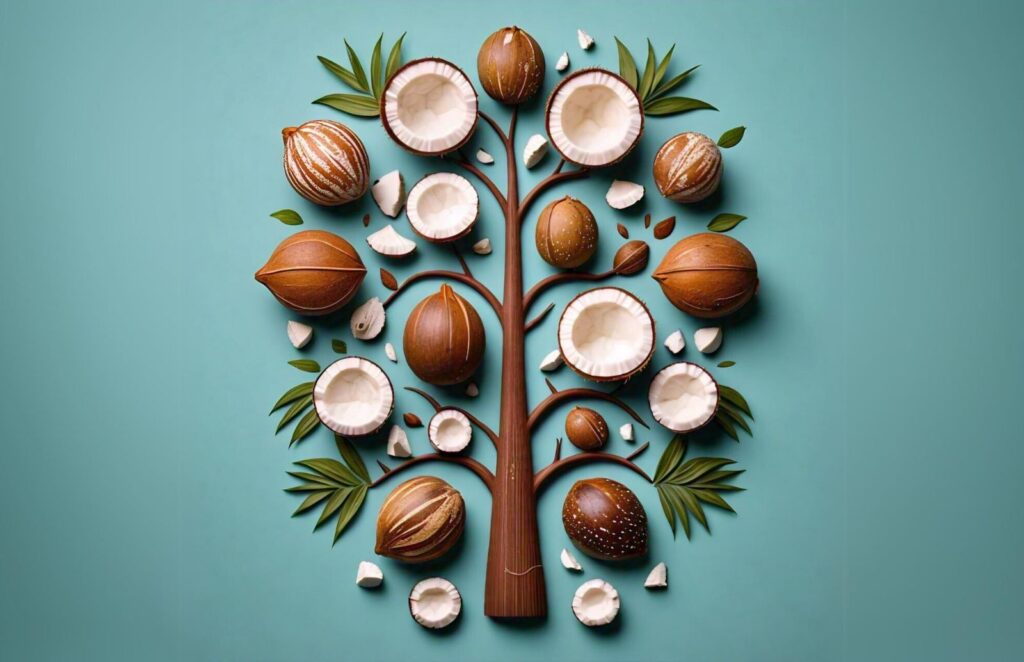
Among the coir fibers on a coconut, you’ll find a soft, spongy pith. This is coconut peat, and it’s used in horticulture as an excellent anti-fungal growing medium, as well as a means of increasing soil aeration and moisture retention.
Coconut peat is also used in water filtration and the production of biodegradable products.
Coconut meat
Here’s where things get tasty. Coconut meat – the delicious, white flesh of the coconut – has a staggering number of applications in the culinary world. It’s fabulous fresh as a tasty snack, but in its flaked, desiccated or ground forms it’s brilliant in desserts, baked goods, and healthy snacks.
Blending the coconut meat with water produces coconut milk, which is thick and creamy, and makes for a wonderful milk substitute. Coconut milk is used extensively in Indian and Southeast Asian cuisine.
Coconut cream is the thicker version of coconut milk, made by blending a higher proportion of coconut meat with less water than is used to make coconut milk. Coconut cream makes a great dairy-free substitute for desserts such as ice cream.
As explained above, drying coconut meat produces copra, from which coconut oil is extracted. There are two main types of coconut oil.
Once the coconut oil is extracted, it can undergo additional refinement to create Refined, Bleached and Deodorized (RBD) coconut oil. This oil is light-colored, with a neutral taste, making it a perfect functional ingredient for roasting, frying, baking, and sautéing.
Virgin coconut oil, or VCO, undergoes less processing, which results in a purer, more nutrient-dense oil that retains a mild coconut flavor and aroma. It’s perfect for cooking and baking applications in which coconut characteristics are preferred.
Coconut water
Coconut water has long been hailed for its nutritional properties and is popular as a healthy drink, but its applications extend beyond the realm of private-label brands offering a nutritious alternative to soft drinks.
Coconut water has a range of applications in the skincare and beauty space due to its natural antioxidant and hydrating properties, as well as the presence of anti-aging cytokinins in the water.
Coconut water also has extensive applications in the textile industry, where it is used to create the sustainable cellulose used for viscose rayon and other fibers.
Go nuts for coconut
No matter what industry you’re in, it’s likely you’ll find a useful application for coconut. For private-label brands looking to capture niche markets, coconut stands as the low-hanging fruit, so to speak.
As a top importer of coconut, over the years, Source86 has had the privilege of working with the best coconut farmers, suppliers, and manufacturers in the world, which means we’re perfectly positioned to reliably meet all your coconut wholesale inventory needs.
Give our team a call to find out how our wholesale importing solution can help make coconut a stable part of your brand journey today.