By strategically choosing between specialized suppliers for hero ingredients and broad distributors for commodities, brands can build a resilient supply chain that serves as a competitive advantage.
Most CPG brands switch ingredient suppliers at least once because they chose wrong early on. The problem is rarely that good suppliers don’t exist. It’s that buyers didn’t know what questions to ask before committing.
A supplier relationship touches everything: your label claims, your retailer compliance, your cost per unit, and your ability to scale. Getting it wrong means reformulation costs, failed audits, and missed launch windows. Here is what procurement managers, R&D leads, and founders should look for before signing with any bulk ingredient supplier.
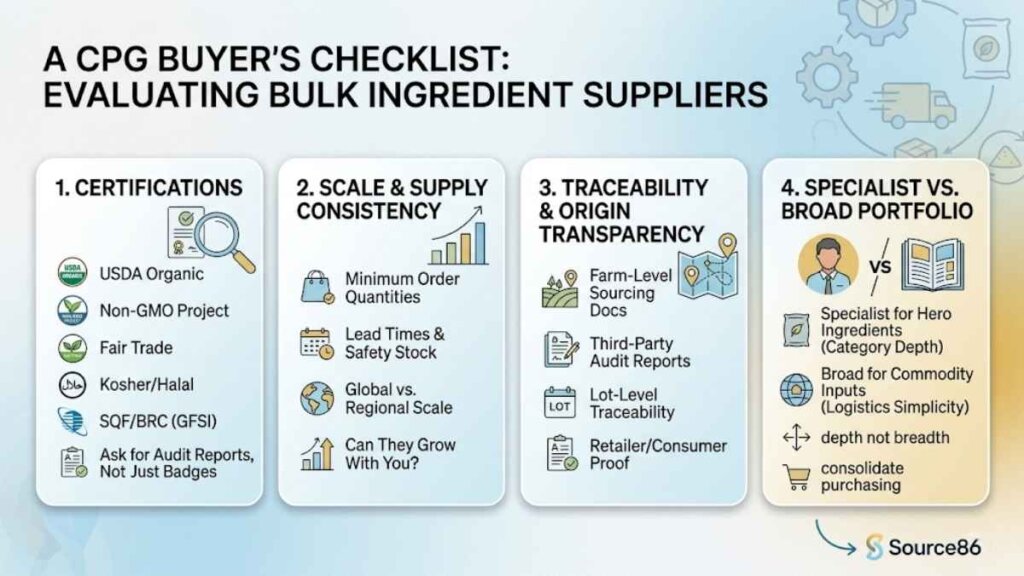
Certifications That Match Your Product and Channel
Not every certification matters for every product. The right ones depend on your category, your retail channel, and your target consumer.
- USDA Organic: Covers growing standards (no synthetic pesticides or fertilizers) but says nothing about food safety or nutritional quality.
- Non-GMO Project Verified: Runs rigorous GMO avoidance testing across every supply chain stage. Does not require organic practices.
- Fair Trade: Addresses ethical labor conditions and fair farmer pricing. Makes no claims about food safety or quality specs.
- Kosher / Halal: Confirms compliance with specific religious dietary laws. Not a substitute for organic, non-GMO, or safety certifications.
- SQF / BRC (GFSI): Recognized food safety management systems covering facility-level controls. Makes no claims about origin or sustainability.
A certificate is a point-in-time snapshot. Always ask for the most recent audit report, not just the badge on their website.
Scale and Supply Consistency
The most common question buyers forget to ask: can this supplier actually grow with you? A supplier optimized for 20,000 lb minimums is the wrong partner if you’re running 2,000 lb pilot batches. A regional distributor with no safety stock policy is a serious risk once you’re in national retail.
Four things to establish before you commit:
- Minimum order quantities: Know the floor before negotiations start.
- Lead times: Get a written commitment, not an informal estimate. Ask what lead times look like during peak demand, not just standard operations.
- Safety stock and inventory buffers: Does the supplier hold inventory, or are they sourcing to order?
- Global vs. regional scale: Suppliers like Ciranda and Tradin Organic operate with vertically integrated, global-scale supply chains. Others are more regional. Neither is inherently better. It depends entirely on your volume needs and how important geographic origin is to your brand.
Traceability and Origin Transparency
In 2026, “we source from trusted suppliers” is not a good enough answer. Retailers want documentation. Consumers want proof. Regulators want audit trails.
Good traceability practices look like this:
- Farm or origin-level sourcing documentation, not just country of origin
- Third-party audit reports, not self-reported data
- Lot-level traceability that can be traced backward in a recall situation
- Consistent records that travel with the ingredient through each supply chain handoff
Some suppliers have built traceability into their core business model. iTi Tropicals focuses on direct sourcing relationships for tropical fruit ingredients, which offers stronger origin transparency for that category. Smirks takes a similar approach for specific specialty inputs. If traceability is a brand pillar for you, look for suppliers who treat it as an operational function rather than a marketing claim.
Specialist vs. Broad Portfolio Suppliers
There is no universal answer here. Both supplier types have a place in a mature CPG procurement strategy.
- When a specialist makes sense: If you’re sourcing a high-value ingredient where category depth and traceability matter, a specialist usually has stronger relationships and better documentation. Meelunie is well-regarded in starches and sweeteners. iTi Tropicals for fruit concentrates and coconut derivatives. Their competitive advantage is depth, not breadth.
- When a broad portfolio supplier makes sense: If you’re sourcing across multiple categories and logistics simplicity matters, a supplier like Ingredients Online or Bluegrass Ingredients can reduce vendor count and consolidate purchasing. The tradeoff is generally less category specialization.
A practical approach: use specialists for your hero ingredients and core label claims. Use broader distributors for commodity and secondary inputs.

Questions to Ask Before Signing
Run every prospective supplier through these questions. A supplier who hesitates on any of them is giving you information.
- What certifications do you hold, and can I see the current documentation and most recent audit reports?
- What is your minimum order quantity and standard lead time? How does that change during high-demand periods?
- How do you handle supply disruptions or shortages? Do you maintain safety stock?
- Can you provide traceability documentation to farm or origin level? What does your lot tracking process look like?
- What food safety audits have you completed in the last 12 months? Can I review the full reports?
- Have you supplied brands in national retail? Are you familiar with their compliance and documentation requirements?
- How do you handle quality complaints and non-conformances? What is your average resolution time?
Why it matters
Supplier qualification is not a formality. It is your first line of defense against supply disruptions, recall exposure, and retailer compliance failures. The brands that get this right early don’t just avoid problems. They build supply chains that become a competitive advantage.
For CPG brands evaluating ingredient suppliers or looking to strengthen their sourcing setup, the Source86 team works with procurement and R&D teams to identify the right suppliers, validate quality documentation, and build supply chains built for scale. Reach out to start the conversation.