You open a familiar package almost without thinking. A cookie, a chocolate bar, a soda you’ve had a hundred times before. The first bite lands slightly off. Not bad exactly, just unfamiliar in a way you can’t immediately name.
So you check the label. Then you search online. And almost instantly, you find other people saying the same thing: “Did they change this?” A forum thread. A Reddit post. A news article confirming your suspicion. Yes, something changed.
What follows is rarely just a complaint about taste. It becomes something closer to collective memory in real time: people comparing notes about a product they thought they knew intimately. For CPG brands, this is one of the most predictable and least controllable moments in food marketing. Because what’s being “reformulated” isn’t just a recipe. It’s familiarity.
Why we get so mad when our food changes
Food memory is unusually sticky. Smell and taste are deeply tied to emotional recall, which is why certain products become quietly embedded in personal history: childhood breakfasts, school snacks, late-night comfort foods. They’re not just consumables; they’re part of a routine that feels stable, even when life isn’t.
That’s why reformulation hits differently from other product changes. A new phone design or a different shoe model can be evaluated on function. But food bypasses that rational layer almost entirely. It’s immediate, sensory, and emotional.
When something tastes “wrong,” the reaction is rarely about ingredients in isolation. It’s about expectation collapse: the gap between what your brain predicted and what your senses delivered. Even small shifts in sweetness, texture, or aroma can feel disproportionate because the reference point isn’t a specification sheet. It’s memory.
And memory, especially food memory, doesn’t update easily. It holds onto versions of products that may no longer exist in any manufacturing line, but still exist very vividly in people’s minds.
New Coke: the granddaddy of reformulation disasters (1985)
In April 1985, Coca-Cola made one of the most famous product decisions in modern consumer history. Facing increasing pressure from Pepsi in blind taste tests, the company replaced its original formula with a sweeter new version.
On paper, it made sense. In controlled testing, consumers often preferred the updated taste. But what those tests couldn’t capture was identity.
The reaction was immediate and unusually intense for a beverage. Customer service lines were overwhelmed. Loyal consumers wrote letters in protest. Some people reportedly hoarded remaining bottles of the original formula, which quickly took on an almost symbolic status. It wasn’t just soda anymore; it was the “real” Coke.
Within about three months, Coca-Cola reversed course and reintroduced the original formula as “Coca-Cola Classic.”
The lesson became a staple in marketing case studies, but it’s often oversimplified. Coca-Cola didn’t fail at research; it followed what the data suggested. The real miss was assuming the product was only being evaluated on taste. For millions of consumers, it wasn’t a beverage swap. It was a disruption to something emotionally anchored.
Or, put differently: people didn’t want a better Coke. They wanted their Coke.
Tropicana’s 2009 packaging redesign
Not all “recipe” backlash involves ingredients. In 2009, Tropicana redesigned its packaging, replacing the iconic orange with a straw design with a minimalist, modern carton.
The juice inside didn’t change. But the product on the shelf suddenly did.
Consumers struggled to recognize it. In a category where purchase decisions are often made in seconds, that matters more than it sounds. Within roughly two months, sales dropped sharply, and the company reverted to the original packaging.
What this episode made clear is how loosely the idea of “recipe” can be defined. For many customers, the experience of a product includes its visual identity, its shelf presence, even the small ritual of grabbing the same familiar carton during a routine grocery run.
Change any of those elements, and you risk altering the product as it exists in the consumer’s mind, even if nothing in the ingredients list has moved at all.
Cadbury and the chocolate that “tasted different”
Chocolate sits in a category where tiny adjustments matter more than most companies would like to admit.
Cadbury has faced repeated consumer pushback over the years, particularly around changes to Dairy Milk and later under different ownership structures. After reformulations and sourcing adjustments, many consumers in the UK and Australia insisted the chocolate no longer tasted the same. The company, in turn, maintained that core recipes remained consistent or only minimally adjusted.
Both things can be true in different ways. Cocoa sourcing, milk composition, and processing techniques can shift subtly over time, sometimes for supply chain or cost reasons, sometimes due to regulatory or formulation constraints. These changes may be technically small, but perceptually large.
Chocolate is especially sensitive to this gap. It carries a high degree of “flavor memory” because people don’t just eat it occasionally; they build long-term familiarity with it. That familiarity becomes a baseline, and anything outside it registers as deviation, even if the specification sheet suggests continuity.
The result is a familiar tension in reformulation stories: companies pointing to consistency, consumers pointing to difference, and neither side being entirely wrong.
Hydrox vs. Oreo: the original that faded out
Hydrox is one of the more quietly ironic stories in packaged food history. Launched in 1908, it predated Oreo by several years. But over time, through ownership changes, recipe adjustments, and shifting shelf presence, it slowly lost ground in the marketplace.
By the 1990s, Hydrox was discontinued, later returning briefly but never reclaiming its earlier position in American pantries.
What makes this case interesting is that there was no single dramatic moment of backlash. Instead, it was erosion. Small changes accumulate: a slight tweak in formula here, a packaging refresh there, reduced visibility on shelves, and changing consumer habits.
Reformulation doesn’t always fail loudly. Sometimes it fades quietly, until the original product becomes something people remember more than they buy.

The modern wave: sugar cuts, color removals, and clean-label pressure
Today’s reformulations are happening under a different set of pressures than in 1985. Brands are adjusting recipes in response to evolving nutritional expectations, regulatory shifts, and ingredient transparency demands. Sugar reduction, removal of artificial colors, and simplification of ingredient lists have become common goals across categories like cereal, snacks, and beverages.
Some of these changes are nearly invisible to consumers. When done carefully, they preserve the sensory profile while adjusting formulation behind the scenes. Others are more noticeable, especially when texture or sweetness is altered in pursuit of a “cleaner” label.
This is also where modern reformulation becomes more complex than historical examples. Brands aren’t just reacting to competitors; they’re responding to shifting health narratives, policy changes in different regions, and broader cultural debates about food processing.
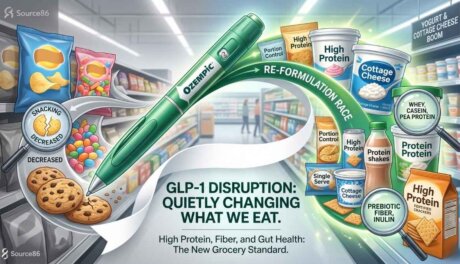
It’s part of a wider industry moment, one that connects directly to the wave of recipe changes quietly happening right now alongside broader shifts in how people eat and what they expect from food.
And the same rule keeps reappearing: consumers may not read ingredient statements closely, but they will notice when something feels different.
Why reformulation is so risky, even when the company is right
One of the most difficult realities in CPG is that reformulation can succeed technically and still fail emotionally. A product can be healthier, more sustainable, or more cost-stable, and still be rejected by the people who buy it most often.
That’s because consumers aren’t benchmarking products against internal R&D goals. They’re benchmarking against memory. And memory doesn’t update in sync with supply chains.
This is where the tension sits: companies are often making rational, necessary changes. Consumers are responding to sensory continuity. Neither perspective cancels the other out.
Reformulation is hard, not because companies don’t understand their products, but because they can’t fully control how those products live in people’s minds.
What brands have learned (and keep re-learning)
Over time, companies that have navigated backlash tend to converge on a few strategies. Gradual rollouts usually work better than abrupt overhauls. Many brands also keep legacy versions available during transitions or test changes in limited markets before scaling nationally. Perhaps most importantly, successful companies pay attention when consumers react, even when that reaction is louder than expected.
Because reformulation isn’t a one-time decision. It’s an ongoing negotiation between product evolution and consumer memory.
And if there’s a quiet takeaway from decades of these moments, it’s this: every familiar product on a shelf exists in a kind of dual state. One version lives in manufacturing systems. The other lives in memory. And the distance between the two is where most of the controversy begins.