



Bulk Cassava
Source86 supplies bulk cassava flour and cassava starch milled from the root of Manihot esculenta, at 30 to 150 mesh depending on grade. Moisture runs 8 to 14 percent maximum across the range, and shelf life spans 12 to 24 months by grade and storage condition.
Flour is available unpeeled, gelatinized, and in extra fine, fine, and medium cuts, alongside a standard all purpose grade. Starch is milled separately to a finer sieve target and carries its own moisture ceiling. Cassava is naturally gluten free and carries almost no protein, fat, or fiber, running close to pure starch by composition.
Grades cover conventional and certified organic programmes, with select organic lots also certified fair trade, kosher, and halal. Supply is concentrated in Nigeria, Brazil, and Thailand, with additional volume from India, Honduras, and Sri Lanka.
Product Data
| Botanical Identity | Manihot esculenta root |
|---|---|
| Available Forms | Flour (standard, unpeeled, gelatinized, all purpose) and starch |
| Particle Size | 30 to 150 mesh by grade, with starch milled to the finer end of the range |
| Moisture | 8 to 14 percent maximum by grade |
| Energy | Approximately 344 to 361 kcal per 100g |
| Protein and Fat | Under 2.5 percent protein, effectively 0 percent fat |
| Carbohydrates and Fiber | 86 to 90 percent carbohydrate, with fiber typically under 7 percent and varying by grade |
| Sodium | Under 31 mg per 100g |
| Microbiological Limits | Confirmed per lot against total plate count, yeast and mold, coliform, E. coli, and Salmonella limits |
| Certification Status | Conventional and certified organic available; select organic lots also carry fair trade, kosher, and halal certification |
| Origin | Nigeria, Brazil, Thailand, India, Honduras, Sri Lanka |
| Shelf Life | 12 to 24 months by grade and storage condition |
Request More Information
Need a quote, more info, or a sample? Fill out the form below, and we’ll be happy to help.
Are you a vendor? Please contact us here.
Certifications & Compliance
Cassava is sourced under both conventional and certified organic programmes, with qualification records confirmed per lot rather than assumed across the range.
- Certified Organic: Available across flour and starch, with select lots also certified fair trade, kosher, and halal in a single certified programme.
- Non GMO: Supplier declarations available by origin, supported by cassava not being commercially grown from genetically modified varieties.
- Gluten Free Statement: Declared gluten free on file for the majority of flour and starch records, consistent with cassava’s natural composition.
- Allergen Statement: Free from statements confirmed per lot rather than assumed across the range, with several records naming a full free from list.
- Kosher and Halal: Certification on file for select organic vendors, confirmed by producing facility.
- Fair Trade: Certification on file for select Brazilian organic lots, confirmed per lot.
- Testing Support: Total plate count, yeast and mold, coliform, E. coli, and Salmonella testing per lot.
- Core Documentation: Certificate of Analysis covering moisture, particle size, and microbiology, with specification sheet, origin documentation, and SDS.
Production & Sourcing
Root is selected and processed into flour or starch through a shared set of steps, with drying and milling adjusted to the target grade.
How It Is Produced
- Root Selection: Mature cassava roots are harvested and sorted for defects ahead of processing.
- Peeling and Washing: Roots are peeled where the grade calls for it, then washed to remove residual soil.
- Grating and Pressing: Peeled roots are grated to a pulp and pressed to reduce moisture ahead of drying.
- Drying: Pressed pulp is dried to the moisture ceiling specified for the finished grade.
- Milling and Sieving: Dried material is milled and sieved to the mesh target for flour or the finer target for starch.
- Packing and Lot Coding: Finished product is packed with lot coding traceable to the source facility.
Applications
- Bakery Manufacturing: Used as a gluten free base flour in bread, cake, and pastry formulations.
- Snack and Extruded Products: Formulated into chips, crackers, and extruded snack systems.
- Sauce and Soup Thickening: Cassava starch is used to thicken sauces, gravies, and soup systems.
- Confectionery and Coatings: Incorporated into gum and confectionery systems calling for a neutral starch base.
- Gluten Free Product Lines: Used across gluten free bakery and snack programmes as a primary flour replacement.
- Traditional and Ethnic Food Manufacturing: Supplied into fufu, garri, and other cassava based traditional food production.
Physical & Functional Characteristics
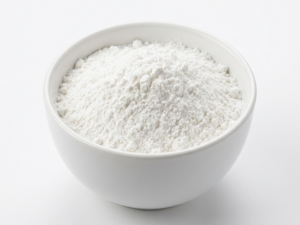
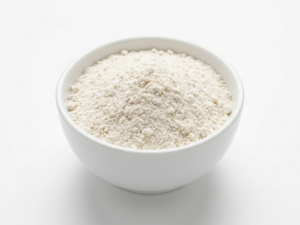
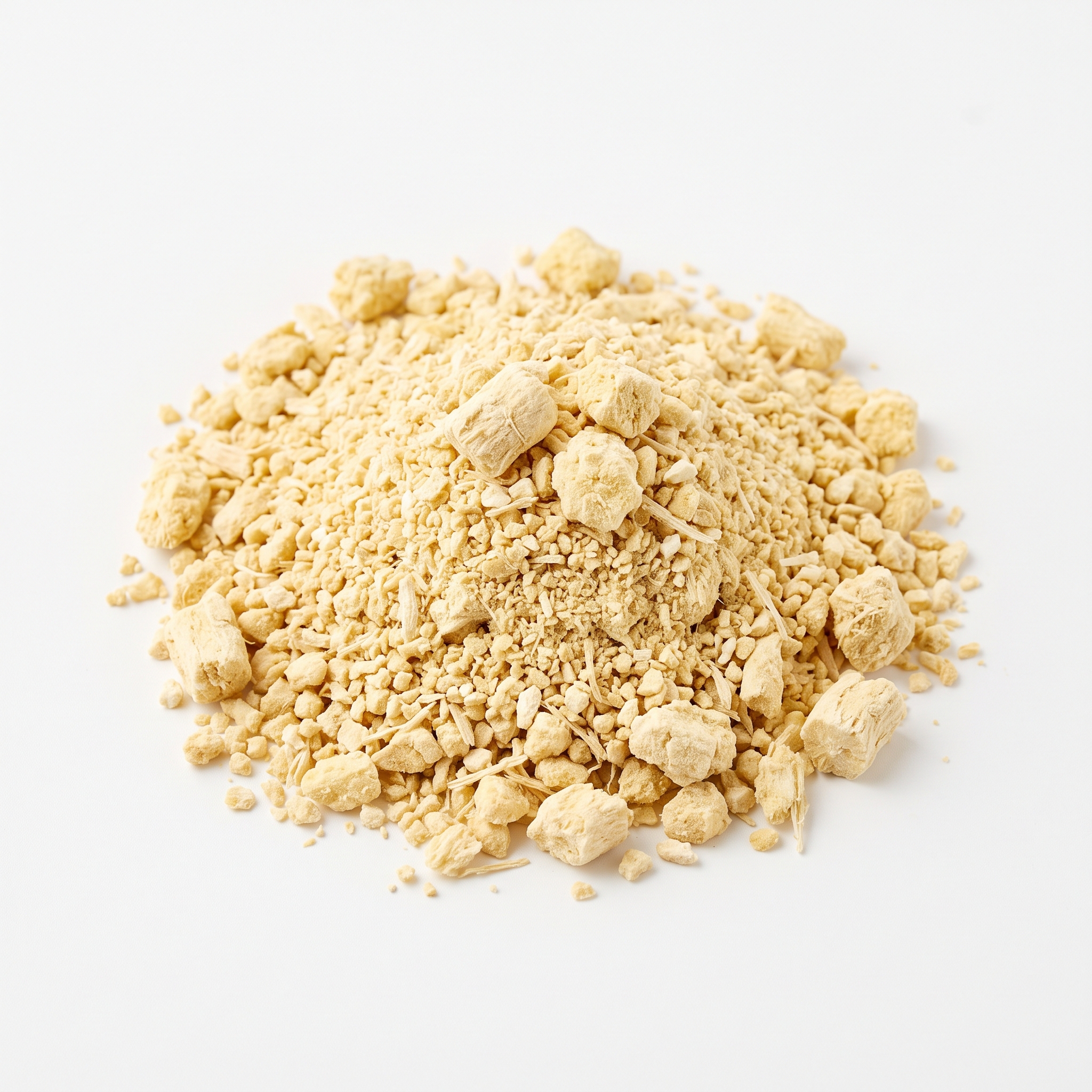
Fine to coarse powder ranging from bright white to off white, with some grades showing dark flecks from unpeeled root.
Neutral to mildly starchy aroma consistent with the root source.
Free flowing powder once milled, with texture varying from fine to coarse by mesh grade.
Predominantly starch and carbohydrate, with minimal protein, fat, and fiber compared to grain flours.
Naturally gluten free and suitable for vegan and vegetarian formulations, with allergen status confirmed per lot.
Runs approximately 350 kcal, 88 percent carbohydrate, and under 2.5 percent protein per 100g, with fiber varying by grade.
Prone to caking under humid storage, requiring moisture controlled handling and packaging.
Functionality
- Gluten Free Structure: Provides bulk and structure in formulations that cannot rely on gluten development.
- Thickening and Gelling: Starch fraction gelatinizes on heating to thicken and set aqueous systems.
- Neutral Flavor Carrier: Contributes almost no flavor of its own, so it does not compete with other formulation components.
- Water Binding: Absorbs and holds moisture in baked and extruded systems, affecting crumb and bite.
- Dry Blend Uniformity: Fine mesh grades disperse evenly through composite gluten free flour blends.
- Moisture Sensitivity: Hygroscopic once milled, so humid ambient conditions risk caking and lump formation.
- Grade Selection by Application: Coarser mesh suits traditional food preparation while finer mesh suits baking and dry blend use.
Benefits for Commercial Manufacturing
- Naturally Gluten Free Base: Removes the need for a separate gluten free certification process on the ingredient itself.
- Both Flour and Starch on One Ingredient Base: Formulators can source the bulking flour and the thickening starch from the same root source.
- Conventional and Organic Both Available: Both programmes run across multiple origins to comparable specification.
- Certified Programmes Bundled on Select Lots: Fair trade, kosher, and halal certification available together on select organic lots, reducing the number of separate qualifications needed.
- Six Origins on File: Supply across Nigeria, Brazil, Thailand, India, Honduras, and Sri Lanka gives sourcing flexibility if one origin faces disruption.
- Documentation Built for Approval: Core documentation and lot level testing support supplier approval files without a separate qualification per grade.