• Skip to primary navigation
  • Skip to main content
Source86

Source86

Importer of specialty raw ingredients, finished products and anything in between

  • Bulk Product List
  • Bulk Ingredients
    • Coconut Ingredients
    • Dried Fruits & Vegetables
    • Fruit & Vegetable Powders
    • Whole & Ground Spices
    • Sweeteners & Syrups
    • Nuts & Seeds
    • Oils & Fats
    • Protein Ingredients
    • Salts & Mineral Seasonings
    • Starches, Gums & Texturizers
    • Botanical Powders & Extracts
    • Pulses & Legumes
    • Cocoa & Chocolate Ingredients
    • Flours
    • Functional Compounds & Additives
    • Grains & Cereal Ingredients
    • Herbs & Leafy Botanicals
  • Retail Ready
  • Company
    • About Us
    • Why Us?
    • Our Services
    • FAQ
    • Careers
    • LinkedIn
    • Contact Us
  • Resource Center
    • Forbes
    • Podcasts
    • Press
    • Learning
    • Leadership & Culture
    • Recalls

Grains & Cereal Ingredients

Source86 supplies bulk grain and cereal ingredients across whole, cracked, puffed, and flaked formats, in both organic and conventional offerings. Our lineup spans traditional crops and ancient grains, including quinoa, barley, millet, and rice. These ingredients provide structure, bulk, and texture across commercial manufacturing lines.

Formulators evaluate protein content, test weight, and moisture when qualifying a grain shipment. Foreign material tolerances and processing state determine how efficiently a lot performs during cooking, baking, or milling.

Showing all 2 results

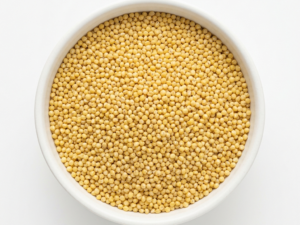
  • Bulk Millet on a white bowl

    Bulk Millet

    Product Details
  • Bulk Quinoa

    Bulk Quinoa

    Product Details

Request More Information

Need a quote, more info, or a sample? Fill out the form below, and we’ll be happy to help.

Are you a vendor? Please contact us here.

Key Product Selection Criteria

  • Variety and cultivar identity: The main differentiator for rice and quinoa, since buyers often select by named variety before comparing raw spec numbers.
  • Protein content: Varies meaningfully by grain type and affects both nutritional profile and structural use in a formulation.
  • Test weight or kernel size: Signals grain density and quality grade, particularly for whole grains sold by the kernel.
  • Processing state: Whole, cracked, puffed, flaked, or pearled versions differ in cooking time and finished texture.
  • Foreign material and defects: Tolerances affect grade classification and incoming inspection pass rates.
  • Moisture: Governs storage stability and spoilage risk across both whole and processed grains.
  • Certification and sourcing: Organic status and origin vary by product and lot.

Common Manufacturing Applications

  • Bakery and milling additions: Wheat bran and wheat germ are used as bakery inclusions and nutritional additions.
  • Breakfast and cereal products: Puffed and flaked grains like millet and teff anchor cereal and granola formulations.
  • Prepared grain and side dish products: Rice varieties and quinoa serve as base ingredients in prepared meal and side dish lines.
  • Snack formulations: Popcorn serves as a base ingredient for snack products.
  • Functional powder applications: Dried barley grass supports functional powder formulations.

Documentation and Qualification Support

Certification and compliance records for this category are confirmed at the product and lot level.

  • Certified Organic, available across much of the range, alongside conventional versions of the same grain
  • Kosher, Halal, and Non-GMO status, confirmed per product
  • Standard documentation, including Certificate of Analysis, Product Specification Sheet, Allergen Statement, Country of Origin Documentation, and Safety Data Sheet
  • Variety and grade documentation, confirmed at the product level for rice and quinoa given their identity-based sourcing
  • Microbiological testing, documented consistently across whole and processed grains

Frequently Asked Questions

Why does variety matter more than a single spec number for rice and quinoa?

Buyers are usually sourcing a specific identity, like basmati or black quinoa, rather than comparing raw numbers across interchangeable options. Variety determines flavor, cook behavior, and visual identity more than any single spec field does.

What’s the difference between whole, cracked, and puffed grain forms? 

Processing state changes cooking time, water absorption, and finished texture. Puffed and flaked forms cook fastest but lose some of the whole kernel’s texture.

Why is test weight used for grains but not for most other categories? 

Test weight reflects kernel density and fill quality, which is specific to how whole grains are graded and traded. Other categories rely on different quality markers suited to their own form.

Are organic and conventional versions available for the same grain? 

For many products in this family, yes. Where both exist, certification and origin are confirmed at the product and lot level.

The brands we supply can be found nationwide at

Walmart logo
Costco logo
Trader Joes Logo
Sprouts Logo 4C
target logo
2560px Whole Foods Market logo
  • Bulk Ingredients
    • Browse Ingredients
    • Complete Product List
  • Company
    • About Us
    • Why Us?
    • Our Services
    • Retail Ready
    • FAQ
    • Careers
    • LinkedIn
    • Contact
  • Resource Center
    • Blog
    • Forbes
    • Podcasts
    • Press
    • Learning
    • Leadership & Culture
    • Recalls

Find Us On

  • Facebook
  • Instagram
  • TikTok
  • YouTube
  • Threads
  • LinkedIn
  • X

Subscribe

Privacy Policy

© 2026 Source86 (formerly ingredient brothers) · Sitemap · Terms · Privacy · Accessibility