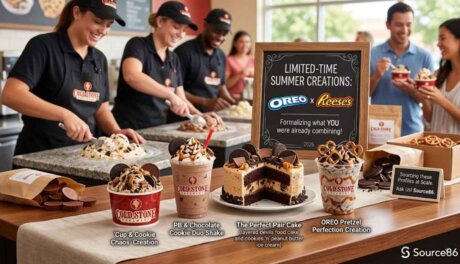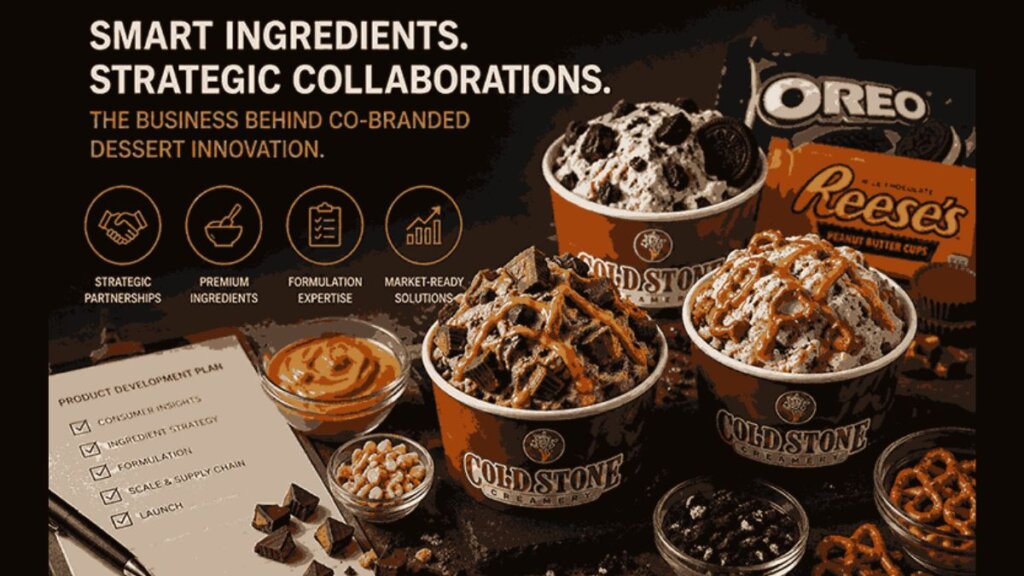
What looks like a seasonal dessert launch at Cold Stone Creamery is actually the result of a sourcing, formulation, and commercialization process that likely started months earlier.
Co-branded dessert launches involving household CPG names like OREO and REESE’S are not just about novelty. They are designed to create operational leverage, ingredient familiarity, and faster consumer trial. They also support higher margin premiumization.
For food manufacturers, co-packers, and R&D teams, these launches offer a repeatable model. They show how branded inclusions move from bulk ingredient sourcing into retail-ready and foodservice-ready SKUs.
The real takeaway is not the menu item itself. The value comes from the formulation logic, supplier coordination, and commercialization strategy behind it.
Related coverage:
The ingredient layer: what’s actually inside the SKUs?
Each co-branded frozen dessert SKU is essentially a layered inclusion system built around recognizable flavor anchors.
A REESE’S-inspired frozen dessert formulation typically relies on peanut butter inclusions with high fat stability, chocolate-coated peanut butter cups, and sweetener balancing to prevent excessive richness in frozen applications.
An OREO-based dessert system centers on chocolate cookie pieces, bulk ingredients engineered for texture retention during frozen storage, often paired with vanilla or chocolate dairy bases that maintain cookie contrast without sogginess.
Pretzel forward dessert SKUs usually incorporate low-moisture pretzel bits designed to preserve crunch throughout the frozen dessert ingredient supply chain while balancing salt-driven flavor enhancement.
Caramel-inclusive products depend heavily on viscosity management and freeze-thaw stability, particularly when caramel ribbons are introduced into high-aeration dairy systems.
In practice, these are not marketing decisions first. They are manufacturability decisions. Inclusion particle size, water activity, shelf stability, and processing compatibility all shape the final SKU before branding conversations even happen.
A typical co-branded dessert launch also requires coordination between flavor houses, dairy suppliers, inclusion manufacturers, and co-manufacturing partners capable of scaling quickly for seasonal distribution windows.
When does a brand actually need an OREO or REESE’S license?
This is where the commercial strategy becomes more important than the flavor profile itself.
A licensed inclusion provides instant consumer recognition and stronger retail differentiation. However, it also introduces higher ingredient costs. It can create longer legal review cycles, stricter packaging approvals, and extended product development timelines.
Working with an officially licensed OREO or REESE’S ingredient system may make sense for nationally distributed launches. In those cases, the brand name can materially impact product velocity and retail placement negotiations.
However, many private label dessert production programs achieve comparable sensory outcomes using non-licensed alternatives:
- chocolate cookie crumb systems
- peanut butter inclusions
- caramel variegates
- chocolate-coated mix-ins
- flavored confectionery particulates
For regional chains, foodservice operators, and emerging CPG brands, generic equivalents often reduce minimum order quantity exposure while dramatically improving speed to market.
That tradeoff matters in food manufacturing partnerships 2026, where launch speed increasingly determines seasonal relevance. A licensed partnership can require extended commercialization timelines tied to approval workflows, whereas a non-licensed formulation strategy allows R&D teams and co-packers to iterate faster and adapt more quickly to ingredient pricing volatility.
The operational question becomes simple. Does the equity of the branded inclusion justify the additional sourcing complexity?
For some retailers and franchise systems, the answer is yes. For many private label programs, flavor familiarity alone is sufficient to drive repeat purchase behavior without the licensing overhead.
This is especially relevant as frozen dessert manufacturers continue balancing premiumization with tighter margin expectations and unpredictable cocoa, dairy, and sweetener costs.
The broader industry pattern
Cold Stone is not operating in isolation. Krispy Kreme, Dairy Queen, and Baskin-Robbins have all leaned heavily into limited-time co-branded desserts, particularly around indulgence-driven flavor systems featuring cookies, candy inclusions, caramel, and hybrid sweet-salty profiles.
The pattern signals a broader shift across frozen desserts. Recognizable inclusions are becoming a shortcut to faster product adoption in both retail and foodservice environments.
According to recent reporting from Mintel, indulgence-focused and nostalgia-driven dessert innovation continues outperforming more restrained flavor categories, particularly among younger consumers seeking familiar branded flavor cues in premium formats.
For suppliers and manufacturers, this creates growing demand for:
- scalable inclusion systems
- retail-ready co-manufacturing
- flexible MOQ structures
- rapid prototyping support
- frozen stable flavor components
The result is a more agile frozen dessert ingredient supply chain where ingredient manufacturers capable of delivering interchangeable flavor systems, licensed or non-licensed, gain strategic value.
Other News
While securing and correctly utilizing powerhouse ingredients like Oreo and Reese’s is the foundational step for any successful co-branding initiative, the real ROI is generated when those backend supply chain strategies are activated for peak consumer seasons. Once the R&D and operational mixing mechanics are dialed in, dessert chains must actively pivot to high-impact, limited-time marketing to maximize the value of the licensed name. Perfectly illustrating how a strong ingredient foundation translates into front-of-house revenue, Cold Stone recently unveiled its massive Summer 2026 menu lineup, aggressively leveraging its Oreo and Reese’s CPG strategy to dominate peak ice cream season. For menu developers and restaurant marketers, tracking this evolution—from securing the raw ingredient in the supply chain to launching a blockbuster summer campaign—demonstrates exactly how to extract maximum value from a blue-chip CPG partnership.
How Source86 fits into this trend
At Source86, the opportunity is not limited to licensed collaborations. Many brands are actively searching for ingredient systems that replicate the texture, indulgence, and familiarity of co-branded desserts without extending development timelines or increasing sourcing risk.
That includes:
- peanut butter ingredient suppliers
- sweetener sourcing partners
- chocolate and cookie inclusion manufacturers
- caramel and variegated suppliers
- co-packers supporting frozen dessert commercialization
As CPG product development strategy becomes more speed-driven, brands increasingly need supplier networks that can support rapid formulation, scalable production, and flexible commercialization pathways with or without a licensing agreement.
The brands moving fastest in 2026 will likely be the ones that understand the difference between borrowing brand equity and engineering the same sensory outcome more efficiently.