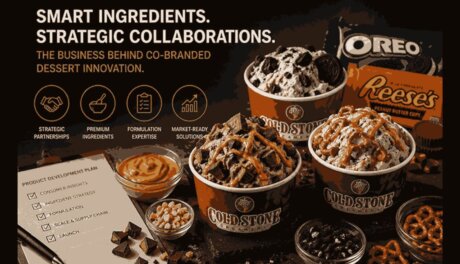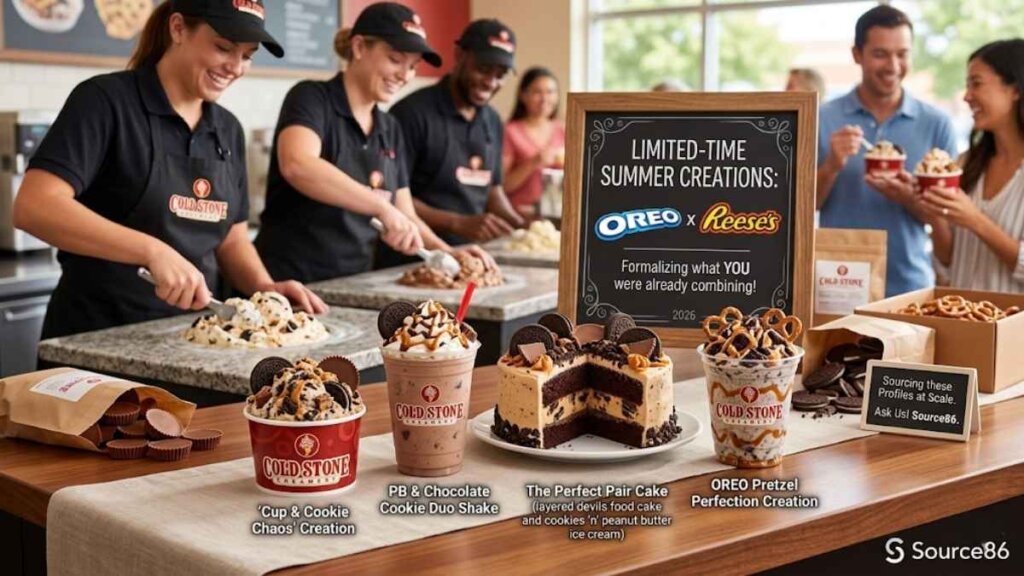
Cold Stone Creamery dropped its OREO and REESE’S summer Creations lineup on May 13, 2026. Four new products. Two iconic licensed brands. One limited-time window before Labor Day.
But the real story for food brands isn’t the flavor. It’s the strategy.
What Cold Stone did this summer is not unusual. What makes it worth paying attention to is how precisely it reflects a repeatable product development model that is reshaping how frozen dessert brands, private label producers, and CPG operators think about what to put on shelves next.
The Products: What’s Actually Inside
Four SKUs define the lineup. Each one is worth unpacking at the ingredient level, not the marketing level.
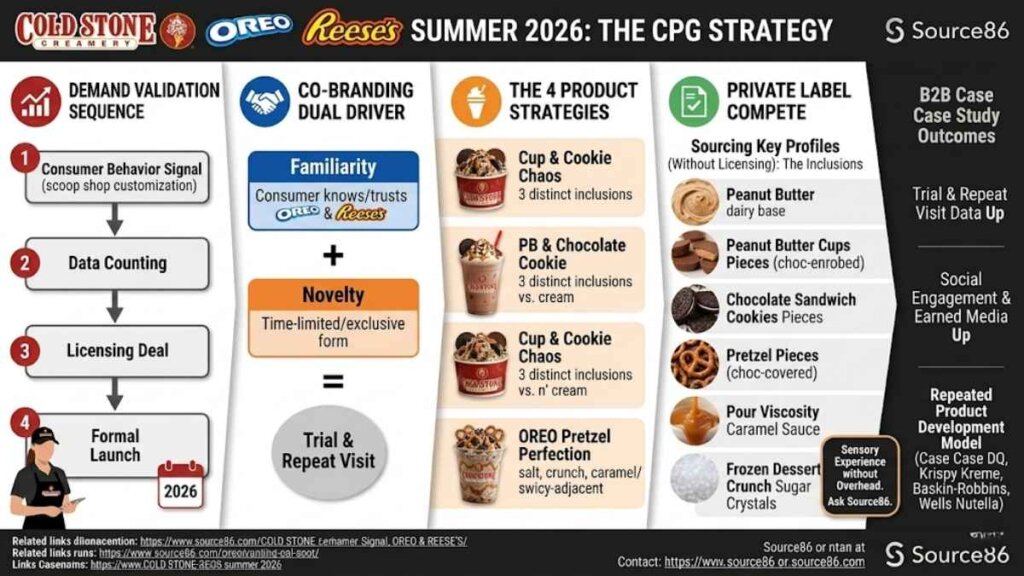
Cup & Cookie Chaos Creation uses Cold Stone’s new Cookies ‘n’ Peanut Butter Ice Cream as the base, topped with REESE’S Peanut Butter Cups and OREO REESE’S Cookies. The formulation stacks three distinct inclusions: a peanut butter dairy base, a chocolate-enrobed peanut butter cup piece, and a chocolate sandwich cookie piece with peanut butter filling.
PB & Chocolate Cookie Duo Shake builds on the same base, topped with whipped cream, REESE’S peanut butter sauce, and OREO cookie pieces. The sauce is a pourable peanut butter compound system, distinct from the cup inclusion.
The Perfect Pair Cake layers Devil’s Food Cake with Cookies ‘n’ Peanut Butter Ice Cream. A cake-and-ice-cream format requires the two components to maintain structural integrity at frozen serving temperatures while delivering distinct textures in the same bite.
OREO Pretzel Perfection Creation moves in a different direction: chocolate-covered pretzel ice cream base with pretzel pieces, caramel, and sugar crystals. This is the swicy-adjacent move in the lineup, replacing the peanut butter axis with salt, crunch, and caramel sweetness.
Why Cold Stone Formalized What Consumers Were Already Doing
Jana Schneider, Cold Stone’s spokesperson, made a telling disclosure in the launch announcement: consumers had already been combining OREO cookies and REESE’S products in their custom orders before Cold Stone ever put these combinations on the menu. Cold Stone watched, counted, and then launched.
That sequence matters for product developers. Cold Stone did not build a licensed collaboration and then wait to see if anyone wanted it. It identified a consumer behavior pattern that was already generating revenue at the counter, then formalized it into a dedicated flavor platform with a licensing structure behind it.
For food brand managers and R&D leads, the Cold Stone OREO & REESE’S launch is a case study in demand validation before product development rather than product development before demand validation. The licensing deal with Hershey’s (which owns REESE’S) and Mondelēz International (which owns OREO) came after the consumer behavior signal was clear, not before.
The Industry Pattern: Co-Branding Is a System, Not a One-Off
The Cold Stone model is not unique. It is one of the most consistently executed playbooks in frozen dessert.
Krispy Kreme’s Lotus Biscoff and HERSHEY’S partnerships followed the same sequence. Dairy Queen’s Blizzard of the Month program has been formalizing consumer flavor preference data into licensed collaborations for years. Baskin-Robbins’ celebrity and brand collabs follow similar consumer signal logic. The common thread is not licensing as a starting point but as a validation mechanism for what consumers are already telling brands they want.
The frozen dessert category is in active premiumization in 2026. Mintel data on the U.S. ice cream category confirms that co-branded and licensed flavor launches have become one of the primary levers for driving trial and incremental purchase among existing category buyers. The mechanic works because it combines two distinct purchasing drivers simultaneously: familiarity (the consumer already knows and trusts the OREO and REESE’S brands) and novelty (the combination is new, time-limited, and exclusive to Cold Stone).
That dual driver is what makes co-branded frozen dessert launches outperform solo flavor launches in social media engagement, earned media pickup, and repeat visit data. A new flavor that is genuinely new requires the consumer to take a risk. A new combination of two brands they already love asks the consumer only to take a chance on a format, not on an unfamiliar taste.
Wells Enterprises’ Nutella Ice Cream launch, which we covered earlier this week, uses the same architecture at the retail shelf level: a licensed ingredient (real Nutella) as the named co-brand within a product produced by the world’s largest private ice cream manufacturer. The sourcing logic and the consumer trust transfer are identical to what Cold Stone executed at the scoop shop level.
You Don’t Need a Hershey’s Deal to Compete in This Category
For private label dessert brands, frozen snack co-manufacturers, and CPG operators watching this trend, the actionable question is not how to secure a Hershey’s or Mondelēz license. It is how to source the ingredient profiles behind these combinations at commercial scale without the licensing overhead.
Peanut butter inclusions for frozen dessert applications. Chocolate cookie pieces at the particle size and moisture specification for an ice cream base. Caramel sauce at the pour viscosity for a frozen topping application. Chocolate-enrobed pretzel pieces. Sugar crystals for a frozen dessert crunch element. Every one of these ingredient categories exists in a commercial bulk format that delivers the same sensory experience as the licensed version without requiring a brand co-branding agreement.
The Cold Stone launch tells you what consumers want at the flavor architecture level. Source86 helps you source the inputs to build it. If your team is developing in the frozen dessert or co-branded snack space and needs the ingredient infrastructure behind the trend rather than the license, reach out to Source86 and let’s start the conversation: https://source86.com/contact/ .