ARLINGTON, VA (October 16, 2026): Lidl US is recalling one lot of Gelatelli Coffee & Vanilla Gelato with Coffee Sauce & Cookie Pieces because it may be contaminated with Listeria monocytogenes, according to the company announcement published by the U.S. Food and Drug Administration (FDA).
Gelatelli recall: quick summary
The recall followed routine quality testing that detected Listeria monocytogenes in a laboratory sample. The announcement did not identify the source of contamination, leaving the origin of the finding unresolved.
Official recall details
- Recall Announcement Date: October 16, 2026
- FDA Publish Date: October 17, 2026
- Announcing Agency: U.S. Food and Drug Administration
- Company: Lidl US
- Issue: Potential Listeria monocytogenes contamination
- Distribution period: July 19–October 15, 2026
- Distribution area: Lidl stores in Delaware, the District of Columbia, Georgia, Maryland, New Jersey, New York, North Carolina, Pennsylvania, South Carolina, and Virginia
- Reported illnesses: None reported at the time of the announcement
What happened?
The company announcement does not identify the source of contamination. The available information does not establish whether the finding was associated with an ingredient, the production environment, or another stage of manufacturing.
Affected product
Product | Package size | UPC | Lot code | Best By date |
|---|---|---|---|---|
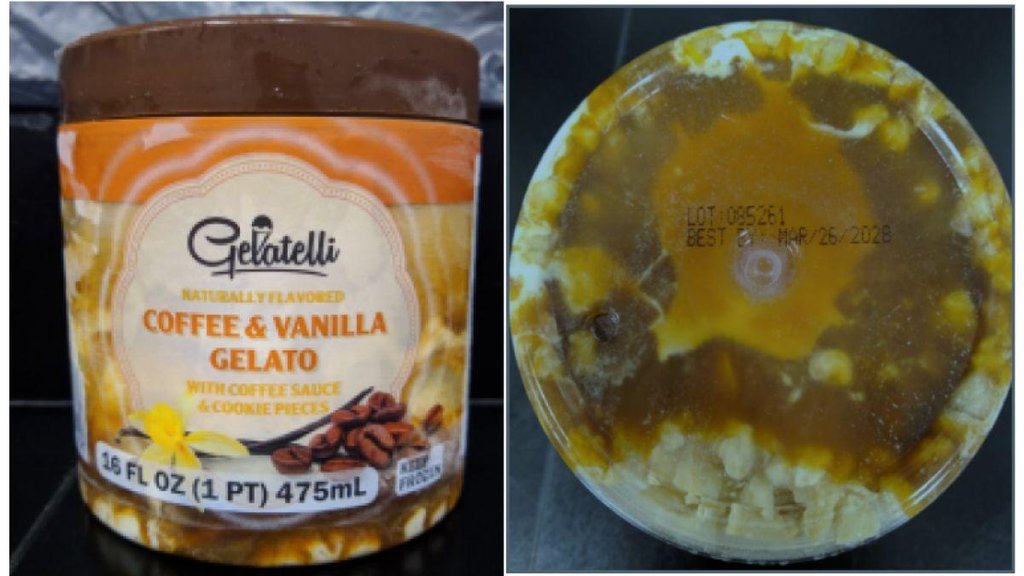
Gelatelli Coffee & Vanilla Gelato with Coffee Sauce & Cookie Pieces | 16 fl oz (1 pint) | 4056489722458 | 085261 | MAR/26/2028 |
Packaging: Clear plastic container with a brown lid. The lot code and Best By date appear on the bottom of the container.
Listeria risks in frozen desserts
Listeria monocytogenes can survive freezing, so frozen storage does not eliminate the pathogen. The FDA’s guidance on L. monocytogenes distinguishes between foods that support the organism’s growth and those that generally do not under specified conditions. A frozen product can still present a contamination risk even when the pathogen does not grow during frozen storage.
Listeriosis can cause fever, headache, stiffness, nausea, abdominal pain and diarrhea. Severe illness is a greater concern for young children, older adults and people with weakened immune systems. Infection during pregnancy can cause miscarriage or stillbirth.
Food safety insight
“When a frozen dessert combines ingredients that were cooked, baked, or pasteurized separately, and sometimes at different facilities, food technologists need to confirm which safety controls apply at each stage of production. Listeria monocytogenes can survive freezing and persist in processing environments, so a validated kill step on one ingredient does not protect components added afterward or those handled again after heat treatment. Reviewing ingredient specifications, supplier controls, post-process handling, and environmental monitoring at the assembly stage helps identify where additional verification, such as ingredient testing or hold-and-release, may be necessary,” said Cherry Ann S. Portugal, Professional Food Technologist at Source86.
Here’s what you should do
Consumers who purchased the affected product should:
- Do not consume the gelato.
- Discard it or return it to the nearest Lidl store for a full refund. A receipt is not required.
- Check the bottom of the container to confirm the lot code and Best By date.
For questions about the recall, contact Lidl US Customer Care at (844) 747-5435, Monday through Saturday, from 8 a.m. to 8 p.m. ET.
Behind the brand
Lidl US introduced its Gelatelli frozen-treat line in 2021, offering gelatos, sorbets and other frozen desserts through its stores. In its launch announcement, Lidl said many Gelatelli products were imported from Europe, although the recall notice does not identify the manufacturer or country of origin for the affected lot.
Other relevant recalls
- Starfish Seafood Recalls Cold Smoked Salmon, Halibut, and Trout Over Listeria Risk
- Kettle Cuisine Recalls Marketside Tomato Bisque Soup Kit Over Possible Listeria Contamination
- City Foods Recalls Pastrami and Corned Beef Over Possible Listeria Contamination
Regulatory context
FDA preventive-controls requirements call for covered facilities to implement controls appropriate to identified food safety hazards. Depending on the facility’s hazard analysis and preventive controls, verification activities may include environmental monitoring or product testing.
The positive laboratory result reported in this recall does not, by itself, establish a regulatory violation or identify the source of contamination. Food safety teams assessing similar incidents should review the applicable hazard analysis, testing records, corrective actions and lot-traceability documentation. See the FDA’s Preventive Controls for Human Food rule.
Ensuring safe eats
For private-label buyers, a recall involving a specific finished product raises a practical question: can supplier and lot records establish whether the issue is limited to that product or extends to other items made with shared ingredients or equipment? In the Gelatelli case, the public notice does not establish a broader impact, so any expansion of the investigation would need supporting traceability and testing records.
Source86 supports food businesses with FSQA oversight, ingredient sourcing and supply chain management. Learn more through Source86’s contact page.