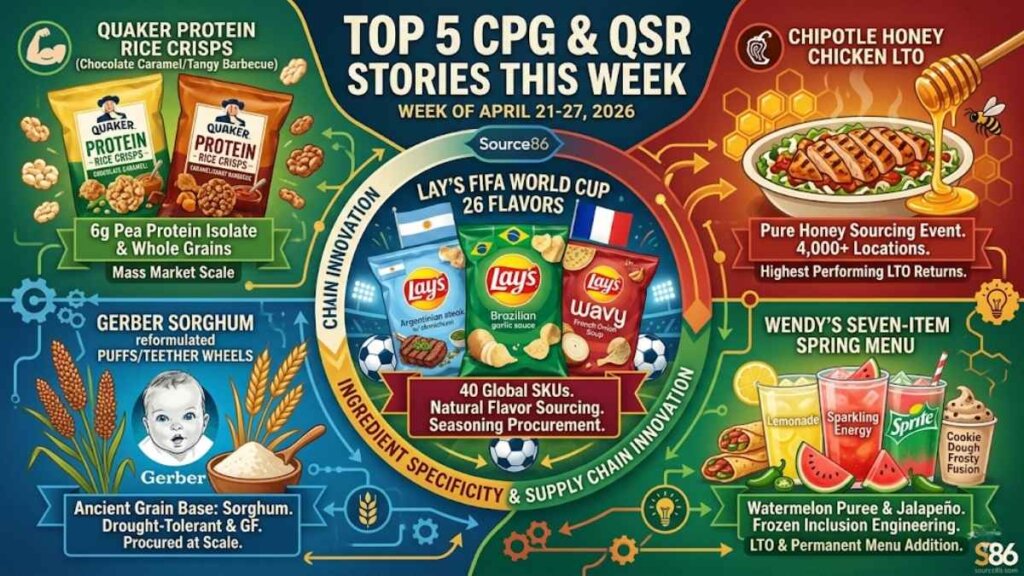
The week of April 21–27, 2026 sent a clear signal to ingredient sourcing teams across the country: protein is everywhere, flavor complexity is the new baseline, and the brands that moved fastest this week weren’t just launching products. They were reconfiguring supply chains.
From a PepsiCo functional snack debut that puts pea protein into a mass-market popped crisp for the first time, to an ancient grain reformulation at the world’s top baby food brand, to a pure honey demand event at 4,000-plus QSR locations, the sourcing implications of this week’s news run deep. Here are the five stories that mattered most.
1. Quaker Protein Rice Crisps: Pea Protein Goes Mass Market
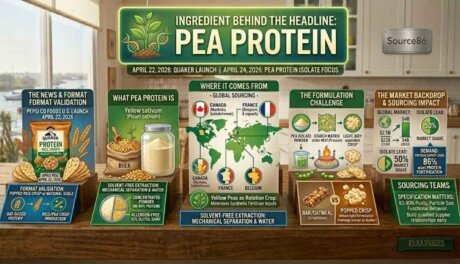
PepsiCo Foods U.S. launched Quaker Protein Rice Crisps nationwide on April 22 in two flavors: Chocolate Caramel and Tangy Barbecue. The product delivers 6g of protein and 9g of whole grains per serving, is gluten free, popped and never fried, and contains no artificial preservatives or flavors. Retail price is $3.29 for a 2.6 oz bag and $5.19 for 5.2 oz.
The protein source is pea protein isolate combined with whole grain rice. That combination is the sourcing story. Pea protein in a granola bar or oatmeal format is established. Pea protein integrated into a popped rice crisp without degrading the light, airy texture is a meaningfully harder formulation challenge, and PepsiCo just put it on shelves at national scale. For pea protein isolate suppliers, this is a new application channel opening at the volume of one of the world’s largest snack food manufacturers.
PepsiCo’s own January 2026 survey backs the commercial logic: 86% of Americans are adding protein to their daily diets, and 70% want protein specifically in their salty snacks. Quaker Protein Rice Crisps is not a trend bet. It’s a confirmed demand response at CPG scale.
Read the full breakdown: Quaker Launches Protein Rice Crisps with Pea Protein and Whole Grains
2. Gerber Switches Puffs and Teether Wheels to Sorghum
Gerber announced on April 22 the reformulation of its Puffs and Teether Wheels snacks, replacing the prior grain base with sorghum. Whole grain content more than doubled, from 2g to 5g per serving. The age recommendation for Teether Wheels also increased from 10 to 12 months, aligned with the developmental stage of older infants. Rollout is already underway on shelves nationwide.
Sorghum is a naturally gluten-free ancient grain with strong fiber, protein, antioxidant, iron, and magnesium credentials. It’s primarily grown in the U.S. Great Plains, drought-tolerant, and carries a lower water footprint than rice or corn. For grain millers and sorghum flour suppliers, this is not a niche brand experiment. This is a sustained procurement shift at the U.S.’s number one baby food brand, applied across two of its highest-volume baby snack lines.
The gluten-free claim at 5g whole grains per serving also tightens the specification significantly. Sorghum inputs for this application must be handled in a dedicated gluten-free processing environment to support the on-pack claim. That raises the bar for eligible suppliers and creates a durable, specification-intensive procurement relationship rather than a commodity grain swap.
Read the full breakdown: Gerber Elevates Baby Food Aisles with Sorghum-Fortified Puffs and Teether Wheels
3. Lay’s Launches 40 FIFA World Cup 26 Flavors Globally
Lay’s announced on April 21 the simultaneous launch of 40 limited-edition potato chip flavors inspired by global cuisine across five continents, tied to FIFA World Cup 26. Three U.S. flavors arrive at retail in early May: Argentinian-Style Steak with Chimichurri, Brazilian-Style Garlic Sauce, and Wavy French Onion Soup. The Argentinian flavor deploys across 23 markets at once.
No other snack brand has executed a coordinated global flavor launch of this scale in a single announcement window. Each flavor requires a distinct seasoning formulation, and Lay’s brand standards prohibit artificial flavors or colors across all applications. That restriction means every herb, acid, dairy compound, smoke flavor, and aromatic spice input across all 40 SKUs must come from natural sources. For seasoning compound manufacturers and flavor house suppliers, this is a high-volume, time-bounded procurement event across multiple ingredient categories and regulatory environments simultaneously.
The chimichurri blend on the U.S. flagship flavor alone requires parsley, oregano, cilantro, basil, bay, thyme, garlic, and lemon profile inputs. The Brazilian-Style Garlic Sauce requires a creamy dairy system. The Wavy French Onion Soup requires aged cheddar flavoring. Three distinct flavor architectures, all natural, all at Frito-Lay manufacturing scale.
Read the full breakdown: Lay’s Launches 40 Limited-Edition FIFA World Cup 26 Flavors Globally
4. Chipotle Honey Chicken Returns at 4,000-Plus Locations
Chipotle announced on April 21 the return of Chipotle Honey Chicken across all U.S., Canada, U.K., France, and Germany locations starting April 28. It was the brand’s highest-performing LTO in history on its 2025 debut. This time it also enters the High Protein Cup format for the first time, reaching the protein-focused ordering occasion directly.
The ingredient story is simple and significant: pure honey at QSR scale. Chipotle’s no-artificial-flavors standard means the honey in the marinade and finish must be pure rather than a honey-flavored compound or blended syrup. At 4,000-plus locations with record-level order demand, this is the largest single concentrated demand event for pure honey as a QSR ingredient that the fast-casual segment has seen to date. For domestic and imported bulk honey suppliers serving foodservice applications, the Honey Chicken return window is a procurement event worth tracking on the calendar.
The 5 CPG ingredient trends shaping 2026 all point toward functional, real-ingredient formulations. Chipotle Honey Chicken is a two-ingredient flavor system (chipotle pepper and pure honey) that hits the clean-label and protein-forward trend simultaneously. That is why it works commercially and why it creates a pure sourcing signal rather than a compound ingredient noise.
Read the full breakdown: Chipotle Returns Its Best-Selling LTO: Chipotle Honey Chicken Available April 28, 2026
5. Wendy’s Spring Menu: Seven Items, Four Ingredient Categories
Wendy’s dropped seven new menu items on April 27, covering breakfast and lunch/dinner simultaneously. The lineup includes the permanent Cookie Dough Frosty Fusion, three limited-time watermelon beverages (Watermelon Lemonade, Watermelon Sparkling Energy, and Sprite Watermelon), and three jalapeño items (Jalapeño Ranch Cheeseburger, Jalapeño Bacon Breakfast Potatoes, Jalapeño Breakfast Biscuit).
No single QSR launch this week activated more distinct ingredient categories at once. Watermelon puree for an all-natural lemonade base. Fresh and pickled jalapeño inputs for three products across two dayparts. Cookie dough inclusions formulated for Frosty service temperatures. Brownie batter sauce that remains pourable when cold. Applewood smoked bacon specified by wood smoke type. Each of these is its own sourcing requirement, and all of them went live at 7,000-plus Wendy’s locations in the same week.
The Cookie Dough Frosty Fusion also represents the most durable sourcing signal of the five: it’s not an LTO. It’s a permanent core menu addition. That means the cookie dough inclusion and brownie batter sauce inputs are now ongoing procurement items at Wendy’s full system volume rather than a finite seasonal window. Bakery inclusion manufacturers and dessert sauce suppliers serving QSR frozen dessert programs should note the distinction.
Read the full breakdown: Wendy’s Launches Seven-Item Spring Menu

The Sourcing Pattern This Week
Five different brands. Five different categories. One consistent signal: ingredient specificity is now a commercial requirement, not a premium positioning choice.
Pea protein that holds texture in a popped crisp. Sorghum processed in a dedicated gluten-free environment. Natural chimichurri herb blends without artificial flavor analogs. Pure honey at QSR marinade scale. Cookie dough inclusions engineered for frozen dairy service temperatures. Each of these is a specification-driven procurement decision, not a commodity buy.
The brands that moved fastest this week were the ones with supply chain infrastructure already built for it. The ingredient sourcing opportunity is in being ready for the next one before it’s announced.
If your team is building sourcing infrastructure for any of the ingredients covered this week, from pea protein isolate to bulk grains to natural flavor systems, reach out to Source86 and let’s build a plan.