




Bulk Pine Nuts
Source86’s bulk banana powder is milled from dried banana at 16 to 80 mesh, depending on grade and drying method. Moisture runs 4 to 8 percent maximum, and shelf life ranges from 12 months on air dried grades to 24 months on freeze dried and spray dried grades.
Three drying methods are available: air drying, freeze drying, and spray drying, the last including a maltodextrin carried juice powder. Composition is single ingredient banana on most lines, with select spray dried and juice powder grades running 95 to 97 percent banana and a 3 to 5 percent maltodextrin carrier.
Grades cover conventional and certified organic programmes on the freeze dried and spray dried lines. Supply is concentrated in China, with additional volume from India and Peru.
Product Data
| Botanical Identity | Pinus spp. seed kernel; Red type is Pinus koraiensis |
|---|---|
| Available Forms | Whole shelled kernels, pasteurized |
| Types and Count Grades | Red 600, 650, 700, 750; Cedar 950, 1050, 1100, 1200 per 100 g |
| Moisture | 3% maximum (2% to 5% across supplier specifications) |
| Aflatoxin B1 | Below 15 ppb |
| Defect Tolerances | Broken kernels 2% max, damaged kernels 5% max, extraneous matter 0.5% max |
| Microbiological Limits | Salmonella absent, Listeria absent in 25 g, E. coli below 10 cfu/g |
| Treatment Status | Pasteurized |
| Certification Status | Conventional or certified organic |
| Shelf Life | 12 to 24 months unopened |
| Storage | 5 to 15°C, 45 to 65% relative humidity, away from light and odours |
| Packaging | Sealed foil bags in cartons |
Request More Information
Need a quote, more info, or a sample? Fill out the form below, and we’ll be happy to help.
Are you a vendor? Please contact us here.
Certifications & Compliance
- Core Documentation: Certificate of Analysis, specification sheet, origin documentation, and SDS issued per lot, with count and moisture reported on the COA.
- Certified Organic: Organic lots ship with organic and transaction certificates and are handled segregated from conventional stock
- Aflatoxin Testing: Aflatoxin B1 is quantitated against the destination market limit, using a sampling plan sized to the lot because contamination distributes unevenly.
- Microbiological Testing: Salmonella, Listeria, E. coli, Enterobacteriaceae, and yeast and mould results are reported per lot against the pasteurized specification.
- Allergen Statement: Pine nut is a declared tree nut under US labelling, and cross contact status is confirmed per packing facility rather than assumed.
Production & Sourcing
Pine nuts are the seeds of pine forests harvested once a year as cones mature in autumn, so supply follows a single annual crop. Source86 sources shelled kernels from processors in northern and northeast China, including Inner Mongolia, where Red and Cedar types are collected, shelled, and graded. Lots of the same Chinese origin are also available through a US based importer, giving buyers a choice between direct shipment and stock already in the country. Every kernel on this page is China origin.
- Cone Collection: Mature cones are gathered after autumn ripening, then dried so the scales open and release the seeds inside.
- Shelling: Seeds are cracked to free the kernel from its hard shell, and shell fragments are separated out by air and screening.
- Sorting and Defect Removal: Broken, damaged, discoloured, and bitter kernels are removed against tolerances such as 2 percent maximum broken kernels.
- Grading by Count: Kernels are sized into count grades per 100 grams, keeping Red and Cedar types apart and organic lots segregated.
- Pasteurization: Graded kernels are pasteurized to reduce microbial load, then held to the 3 percent maximum moisture specification before packing.
- Testing, Packing, and Traceability: Each lot is tested for microbiology and aflatoxin, packed in sealed bags, and coded so results trace back to the lot.
Applications
- Bakery and Patisserie: Breads, biscotti, tarts, and cookies carry Red kernels as toppings and inclusions where the whole kernel stays visible.
- Pesto and Sauces: Fresh and shelf stable pesto, along with nut based sauces and dressings, rely on kernels as a core flavour and body ingredient.
- Snack Mixes: Trail mixes, premium nut blends, and roasted snack packs add pine nuts for size contrast and a higher value position.
- Confectionery: Nougat, brittle, nut pastes, and chocolate inclusions use Cedar counts where a small, uniform kernel suits the finished piece.
- Cereal and Bars: Granola, clusters, and snack bars take smaller kernels as visible inclusions that distribute evenly through the binder.
- Prepared Meals and Salads: Ready meals, grain bowls, and salad kits include kernels as a garnish or component, often toasted at the plant.
- Plant Based Foods: Producers of vegan cheeses, dairy free spreads, and meat alternatives grind kernels for fat, body, and a mild savoury note.
- Mediterranean and Middle Eastern Foods: Stuffed vegetables, rice dishes, kibbeh, and filled pastries use pine nuts as a traditional component in prepared formats.
- Foodservice Ingredients: Restaurant and catering distributors supply bulk packs of kernels for garnishes, sauces, and baked items across menus.
- Nut Butters and Pastes: Specialty butter and paste lines grind kernels into spreads, fillings, and premium sauce bases.
Physical & Functional Characteristics
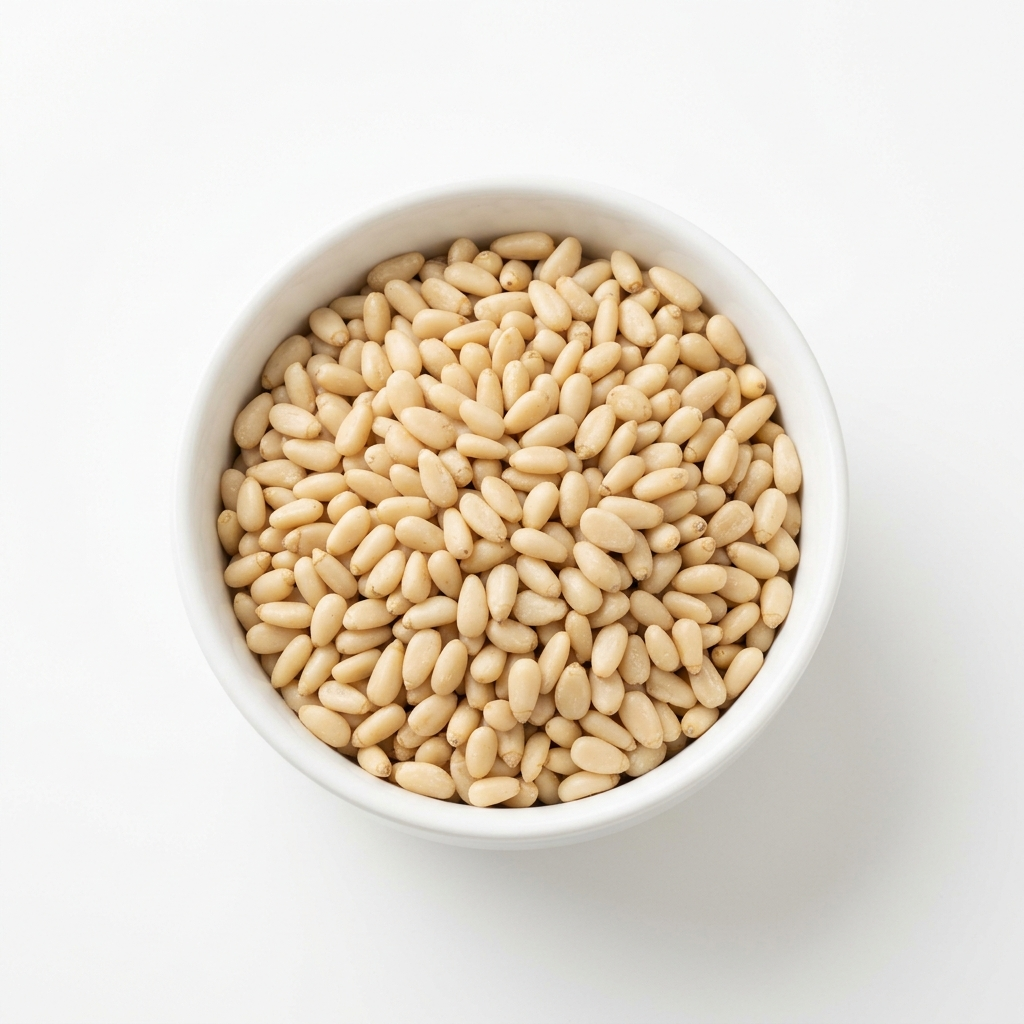
Elongated, teardrop shaped kernels with a smooth surface; Red kernels are plump and broad, Cedar kernels smaller and slimmer.
Milky white to light yellow or pale ivory, with a more yellowish tone on some Red lots.
Mild, buttery, and slightly sweet when raw, with a faint resinous note that becomes more pronounced once toasted.
Light and clean when fresh, while a sharp or painty smell indicates that the oil fraction has begun to oxidise.
Soft and tender with a slightly waxy bite, noticeably softer than most other tree nut kernels.
Single ingredient, 100 percent pine nut kernel, with no salt, coating, or additives on the pasteurized grades.
Roughly 13.7 to 17 g protein and 40 to 68 g fat per 100 g, varying by type and supplier
The fat is largely unsaturated, with combined monounsaturated and polyunsaturated fractions five to ten times the saturated fraction.
At 3 percent maximum moisture the kernel resists microbial growth, but warmth, light, and humidity accelerate rancidity.
At 3 percent maximum moisture the kernel resists microbial growth, but warmth, light, and humidity accelerate rancidity.
Pine nut is one of the 12 tree nuts that require declaration under current FDA allergen labelling guidance.
Funcionality
- Fat Contribution: With 40 to 68 percent of the kernel as oil, pine nuts add richness and mouthfeel without a separate added fat.
- Body and Emulsion in Sauces: Ground kernels release oil and fine solids that thicken pesto and dressings and help stabilise the oil phase.
- Toasting Response: The oil rich, low moisture kernel browns quickly under dry heat, so toasting needs short, controlled times to avoid scorching.
- Piece Size by Count: Count grade sets visual size and distribution, with Red kernels reading as discrete pieces and Cedar kernels dispersing more evenly.
- Bake Stability: Kernels hold their shape through mixing and baking, though toppings exposed to direct oven heat brown faster than inclusions.
- Grinding Behaviour: Soft kernels reduce to paste at low mill energy and release oil readily, so overgrinding turns a coarse meal oily.
- Oil Migration Into Coatings: The liquid oil fraction migrates into chocolate and compound coatings, softening the shell and driving bloom unless a barrier layer is applied.
Benefits for Commercial Manufacturing
- Count Grades Matched to Use: Specifying by count per 100 g matches kernel size to visibility, so buyers avoid paying for size where the kernel is hidden.
- Ready for No Kill Step Lines: Pasteurized kernels with documented Salmonella results suit toppings, salads, and garnishes that receive no further heat treatment.
- Defined Aflatoxin Acceptance: Aflatoxin B1 results reported against the destination market limit give QA a clear acceptance criterion at intake.
- Conventional and Organic Options: Both types are available conventional or certified organic, so standard and organic SKUs can run on matching specifications.
- Two Import Paths: US held stock offers an alternative to direct container shipments from China for smaller or urgent volumes.
- Annual Crop Planning: A 12 to 24 month shelf life under cool storage lets buyers contract against the single annual harvest and draw down through the year.
- Lot Level Traceability: Lot coding tied to COA results lets a manufacturer trace any finished batch back to a tested kernel lot during audit.
- Allergen Programme Support: Facility allergen statements and cross contact disclosures help downstream manufacturers build allergen controls and accurate tree nut labelling.