




Bulk Macadamia Nuts
Macadamia nuts are supplied as shelled kernels graded by style, from whole kernel Style 0 down to Style 6 pieces at 6 to 8 mm, in pasteurized, diced, meal, dry roasted, and roasted and salted formats. Pasteurized kernels run at below 1.5 percent moisture with aflatoxin B1 held below 2 ppb and total aflatoxin below 4 ppb, while roasted grades are held to 2.0 percent maximum moisture and 2.0 percent maximum free fatty acids.
Whole and large styles serve snacking, gifting, and premium confectionery, where kernel size and colour are on display, while diced pieces and meal go into bakery, ice cream, bars, and coatings at a lower cost per pound. Supply is drawn from Australia, South Africa, Kenya, Rwanda, Guatemala, Nicaragua, and Hawaii, giving coverage across both hemispheres. Specifications and documentation are available on request.
Product Data
| Botanical Identity | Macadamia spp., kernel; a tree nut |
|---|---|
| Available Formats | Whole and piece styles, diced, meal, pasteurized, dry roasted no salt, dry roasted and salted |
| Kernel Styles | Style 0 through Style 6; Style 6 pieces at 6 to 8 mm |
| Moisture | Below 1.5% pasteurized; 2.0% maximum roasted |
| Aflatoxin | B1 below 2 ppb and total below 4 ppb pasteurized; 20 ppb maximum roasted |
| Free Fatty Acids | 2.0% maximum on roasted grades |
| Peroxide Value | 4.0 meq/kg maximum on roasted grades |
| Defects | Blemishes and deviations 3% maximum; discolouration and immaturity 2% maximum |
| Shell Tolerance | Impacted shell 1% maximum by weight; loose shell 2 pieces per 100 kg maximum |
| Heavy Metals | Lead below 0.1, cadmium below 0.05, arsenic below 0.25, mercury below 0.02 mg/kg |
| Total Plate Count | Below 10,000 cfu/g pasteurized; below 25,000 cfu/g roasted |
| CertificationsOrigin | Australia, South Africa, Kenya, Rwanda, Guatemala, Nicaragua, Hawaii |
| Shelf Life | 12 months ambient; up to 24 months at 5 to 18°C without oxygen |
| Storage | \Cool and dry, 40 to 55°F at 65 to 75% relative humidity; keep moisture below 1.8% |
| Packaging | 25 lb or 50 lb poly lined cartons |
Request More Information
Need a quote, more info, or a sample? Fill out the form below, and we’ll be happy to help.
Are you a vendor? Please contact us here.
Certifications & Compliance
- Core Documentation: Certificate of Analysis, specification sheet, origin documentation, and SDS issued per lot, with moisture, free fatty acids, and peroxide value reported on the COA.
- Aflatoxin Testing: Aflatoxin B1 and total aflatoxin are tested per lot, with pasteurized kernels held below 2 ppb B1 and 4 ppb total.
- Pasteurization and Microbiological Testing: Pasteurized lots are tested for plate count, Salmonella in 375 g, Listeria, E. coli, and yeast and mould before release.
- Heavy Metals Testing: Lead, cadmium, arsenic, mercury, and nickel are held to stated limits, supporting entry into markets with strict contaminant rules.
- Kosher Certification: Roasted and salted macadamia kernels are Kosher certified, supporting Kosher labelled snack and confectionery lines.
- Allergen Statement: Macadamia is declared as a tree nut, with tree nuts present on line and in facility, and shell dust traces possible.
Production & Sourcing
Macadamia trees grow in subtropical highlands and coastal regions, and nuts fall when mature, so harvest runs through a defined season in each growing country. Source86 sources kernels from processors handling crop from Australia, South Africa, Kenya, Rwanda, Guatemala, Nicaragua, and Hawaii, which places supply in both hemispheres and spreads harvest timing across the year. Kernels are cracked and graded at origin, then pasteurized, diced, milled, or roasted to the purchased format.
- Harvest and Dehusking: Fallen nuts are collected, the green husk is removed, and nut in shell is dried to protect kernel quality.
- Cracking: The very hard shell is cracked mechanically, releasing the kernel while keeping breakage and shell contamination as low as possible.
- Sorting and Grading by Style: Kernels are sorted for colour and defects, then graded into Style 0 through Style 6 by size and wholeness.
- Pasteurization or Roasting: Kernels are pasteurized for raw use, or dry roasted to customer roast level, with salt added on salted grades.
- Dicing and Milling: Pieces are cut to diced sizes or milled into meal for bakery, confectionery, and ice cream applications.
- Testing, Packing, and Traceability: Each lot is tested for moisture, aflatoxin, and microbiology, packed in poly lined cartons, and coded for traceability.
Applications
- Premium Snacking: Whole and halved kernels are roasted, salted, or packed raw for retail snack packs, gift tins, and premium nut mixes.
- Confectionery and Chocolate: Chocolate makers enrobe whole kernels and fold diced pieces into bars, clusters, pralines, and nut brittles.
- Cookies and Bakery: White chocolate macadamia cookies, shortbread, muffins, and tarts use diced pieces and meal for texture and buttery flavour.
- Ice Cream and Frozen Desserts: Ice cream and gelato producers add roasted diced macadamia as an inclusion that stays crisp in frozen storage.
- Cereal and Snack Bars: Granola, muesli, and premium bars carry diced pieces as a visible, high value inclusion.
- Nut Butters and Spreads: Kernels and meal are ground into smooth macadamia butter and blended spreads for retail and foodservice.
- Plant Based Dairy Alternatives: Macadamia milks, creamers, and cultured cheeses use kernels for a rich, creamy, neutral base.
- Coatings and Crusts: Macadamia meal forms crusts for fish, chicken, and bakery toppings, adding crunch and a golden finish.
- Gluten Free Baking: Gluten free cakes, cookies, and crusts use macadamia meal to replace part of the flour while adding fat and moistness.
- Foodservice and Hospitality: Hotels, restaurants, and airline caterers buy roasted and salted kernels for bar snacks and premium amenities.
Physical & Functional Characteristics
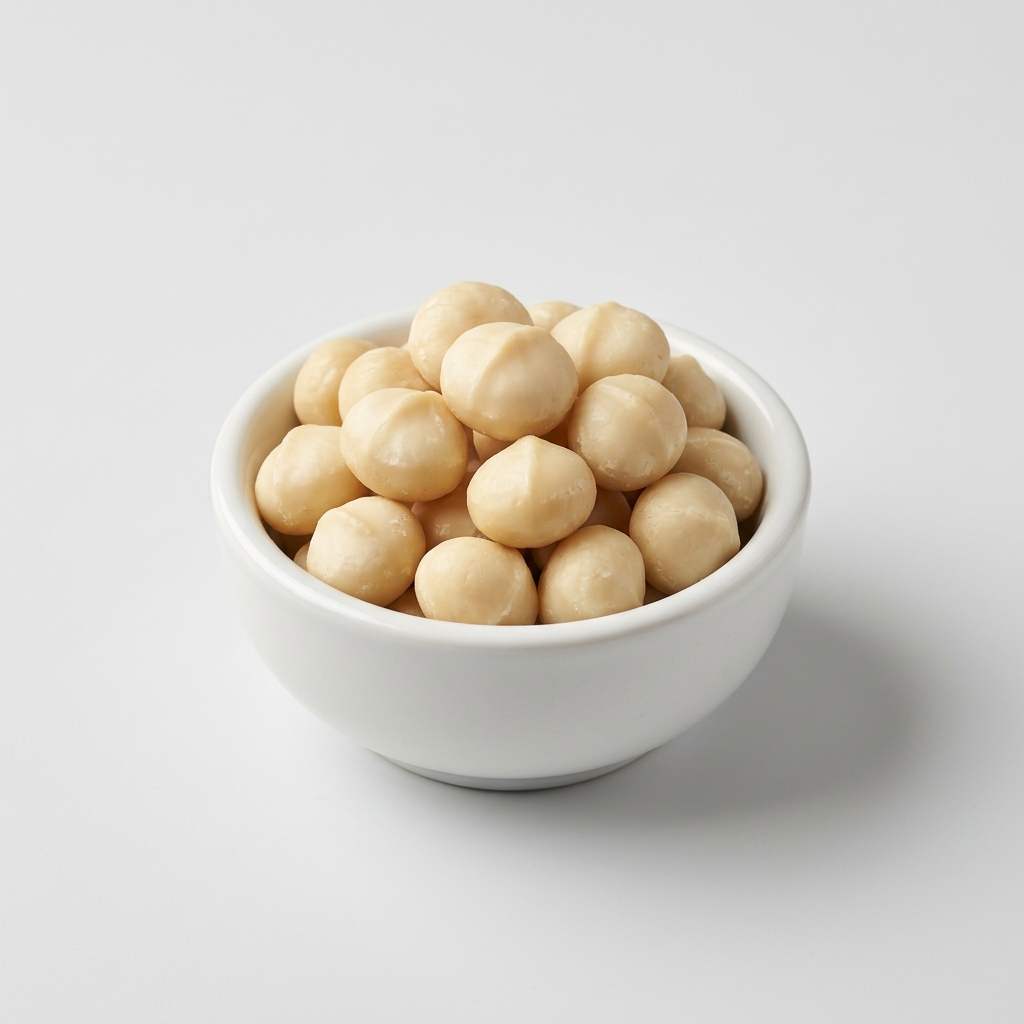
Round, smooth kernels when whole, with flat faced halves and angular diced pieces on cut styles.
Uniform natural cream on pasteurized kernels, deepening to light golden brown on roasted grades.
Mild, sweet, and buttery when raw, becoming richer and more toasted once dry roasted.
Clean and faintly sweet when fresh, while a sharp or painty smell indicates oxidation of the oil fraction.
Firm yet tender with a creamy, melting bite that is softer than almonds or hazelnuts.
Single ingredient, 100 percent macadamia kernel on pasteurized and plain roasted grades, with salt only on salted grades.
About 718 kcal, 75.8 g fat, 7.9 g protein, 8.6 g fibre, and 4.6 g sugars per 100 g.
Pasteurized kernels run below 1.5 percent moisture and must be kept below 1.8 percent to protect texture and shelf life.
Heat, light, and oxygen accelerate rancidity, so free fatty acids and peroxide value are tracked and cool, low oxygen storage is required.
Macadamia is a declared tree nut, requiring allergen labelling and segregated handling in downstream production.
Funcionality
- Fat and Richness: With around 76 percent fat, macadamia adds buttery richness and a soft bite without separate added fat.
- Particle Size by Style: Style selection sets visual size, with whole kernels on display and Style 6 or diced pieces dispersing through doughs and fillings.
- Roast Development: Dry roasting deepens colour and flavour quickly, so roast level is set to specification to avoid scorching the high oil kernel.
- Crunch Retention in Frozen Systems: The low moisture, high fat kernel resists moisture uptake, keeping diced pieces crisp in ice cream and frozen desserts.
- Grinding and Paste Formation: Kernels release oil readily under milling, forming a smooth butter at low mill energy, so meal must be handled cool to avoid clumping.
- Oil Migration Into Coatings: The liquid oil fraction can migrate into chocolate and compound coatings, softening the shell unless a barrier layer is used.
- Seasoning Adhesion: The smooth kernel surface carries salt and seasoning evenly when applied during or straight after roasting.
Benefits for Commercial Manufacturing
- Defined Moisture Grades: 18% and 20% maximum grades let manufacturers select a firmness aligned with processing and texture targets.
- Variety Selection: Deglet Nour, Zahdi, Naghal, and blended grades support different color, sweetness, and flavor profiles across product lines.
- Clean Label Sweetening: A single ingredient fruit paste replaces refined sugar and syrups with an ingredient consumers recognize.
- Batch Consistency: Standardized Brix, moisture, and water activity support consistent sweetness, texture, and processing behavior across production runs.
- Handling Efficiency: A ready to use paste removes pitting, soaking, and milling from your own line and simplifies dosing.
- Shelf Stable Supply: Low water activity and an 18 month shelf life support predictable inventory planning at ambient storage.
- Bulk and Packaging Flexibility: Supplied in 25 kg packs with custom pack sizes for manufacturers, contract packers, and distributors.
- Supply Continuity: Multi origin sourcing across the UAE, Saudi Arabia, Tunisia, and the United States supports availability and reduces single region dependency.
- Documentation Readiness: COAs, specifications, allergen statements, Non GMO and gluten free statements, and process flow charts available on request to support supplier onboarding and QA review.